
Liquid crystal displays are no longer used only in consumer electronics. Today they appear in factory automation panels, outdoor kiosks, medical equipment, and vehicle dashboards — environments where light, dust, oil, and UV exposure can quickly compromise screen performance.
For this reason, surface treatments have become a critical part of display engineering, ensuring that screens remain bright, durable, and easy to interact with throughout their service life.
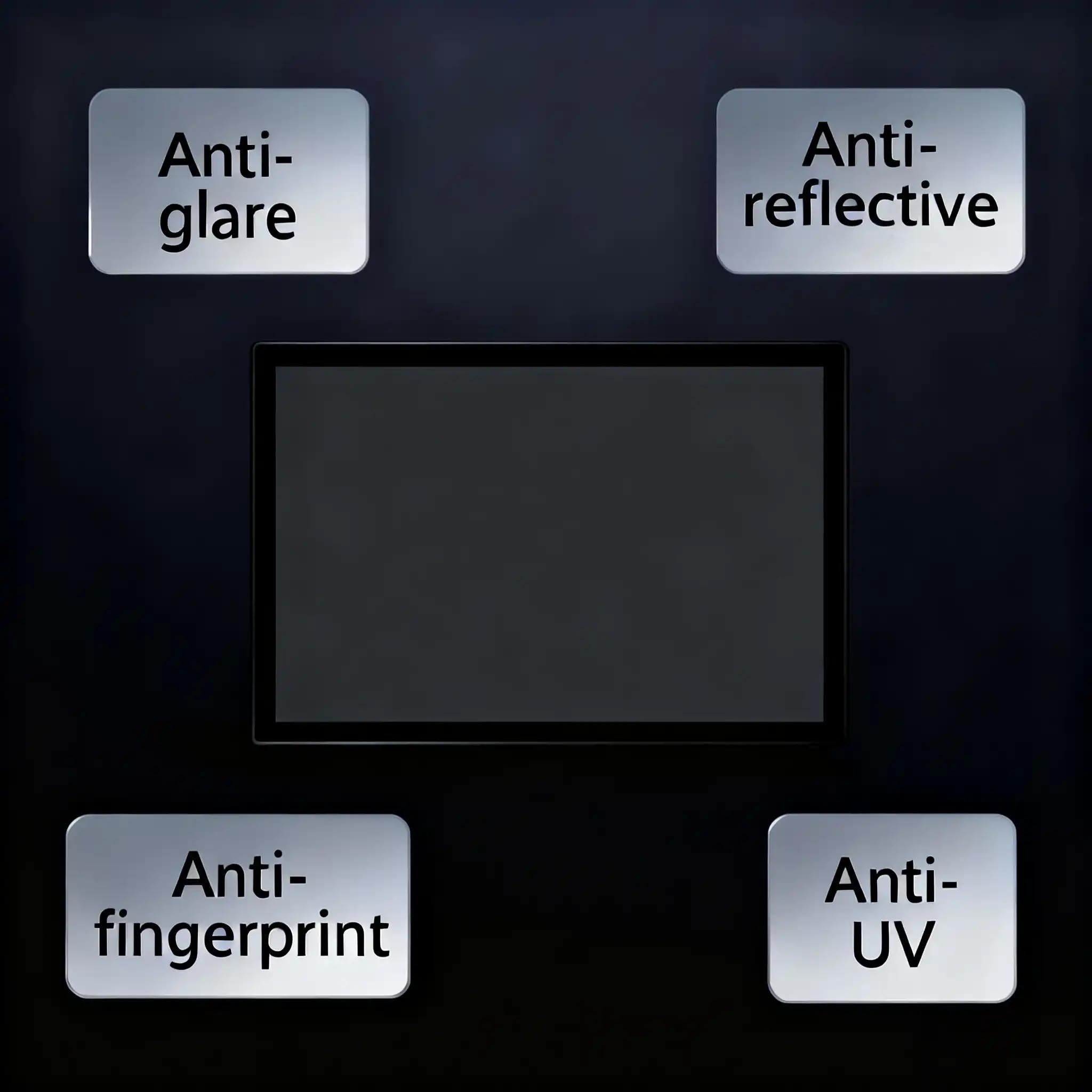
Why Surface Engineering Matters
The optical modules inside an LCD may be highly advanced, but the surface that users look at and touch is equally important. A well-designed treatment layer can:
- Reduce glare and surface reflections
- Increase contrast and readability
- Repel fingerprints and moisture
- Prevent UV-induced aging
- Improve cleaning and maintenance
- Enhance overall user comfort
In short, surface coatings directly affect how a display behaves in the real world — especially in harsh or unpredictable environments.
Common Types of Surface Treatments
Different applications require different characteristics, and no single coating can meet all needs. Below is a practical breakdown of the four most commonly used LCD surface treatments.
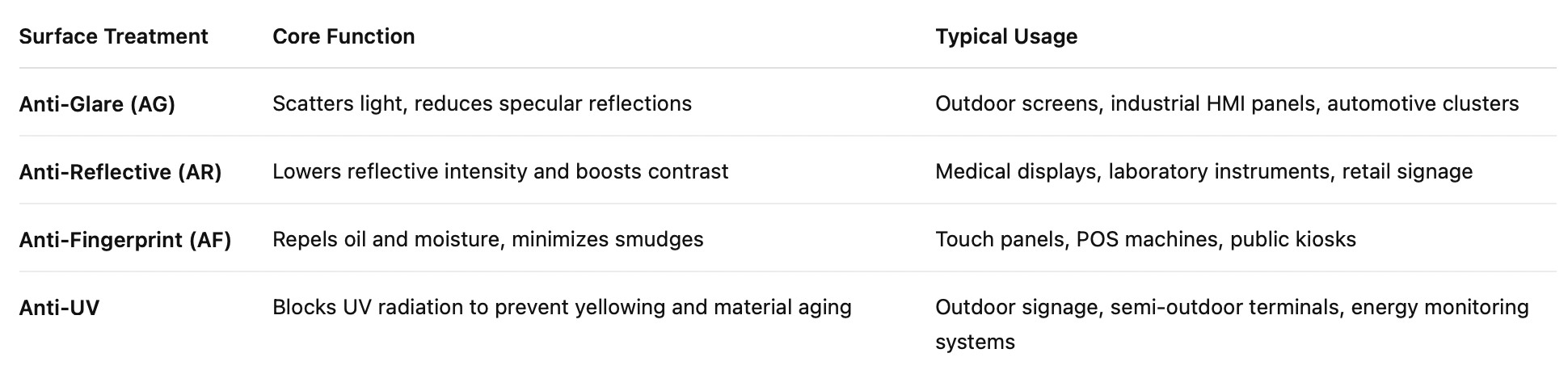
Anti-Glare (AG): Better Visibility in Bright Environments
Anti-glare technology helps maintain readability under intense ambient light. Instead of allowing sunlight or indoor lighting to bounce directly into the viewer’s eyes, an AG surface diffuses incoming light, reducing sharp reflections.
How AG Surfaces Are Made
1. Coating Process
A micro-particle matte coating is applied to the surface. These particles scatter incoming light and soften reflections.
2. Etching Process
The glass or plastic surface is micro-textured through chemical or mechanical etching. This creates a durable, non-coated matte finish that diffuses light naturally.
Benefits of Anti-Glare Treatments
- Clearer visibility in sunlight or bright factory lighting
- Reduced visual strain during long operation sessions
- Consistent readability across wide viewing angles
- Improved usability for industrial and automotive applications
Anti-Reflective (AR): High Clarity and Sharp Contrast
While AG diffuses light, AR coatings minimize light loss by allowing more of the display’s own luminance to pass through.
How AR Improves Visual Performance
AR coatings typically use multi-layer optical films with carefully tuned refractive indices. These layers manipulate destructive interference to cancel out reflected wavelengths on the surface. The result:
- Higher light transmission
- Deeper contrast
- More vivid colors
- A cleaner, reflection-free appearance
Where AR Coatings Are Essential
- Medical imaging and diagnostic monitors
- Point-of-sale and information kiosks
- Precision navigation and measurement instruments
- Retail and commercial signage
Anti-Fingerprint (AF): Cleaner, Smoother Touch Interaction
AF coatings add an oleophobic (oil-resistant) layer to the display, preventing smudges from adhering to the surface. This is especially important for touch-intensive devices.
Why AF Matters
- Keeps screens visually clean even after frequent touching
- Improves swipe smoothness and panel responsiveness
- Reduces haze caused by oily residues
- Allows fast cleaning with minimal effort
Where AF Coatings Are Common
- Smartphones and tablets
- Smart home control panels
- POS and payment terminals
- Public information displays
- Industrial operator panels exposed to dust or oil
Anti-UV: Protecting Against Sunlight Damage
UV radiation is a major threat to long-term LCD performance. Without UV protection, polarizers, adhesives, and optical films begin to degrade — especially in outdoor installations.
Benefits of UV-Blocking Layers
- Prevents yellowing, color fading, and brittleness
- Maintains brightness over extended service life
- Protects optical films and adhesives from decomposition
- Ensures stable clarity in semi-outdoor or outdoor use
Where UV Protection Is Required
- Digital billboards and advertising displays
- Outdoor ticketing and vending machines
- Renewable energy monitoring panels
- Heavy-duty industrial displays used near windows or open areas
Combining Treatments for Specific Applications
Real-world products often require hybrid coatings to balance optical clarity, durability, and usability.
Typical Combinations
- AG + AR
- AR + UV
- AG + AF
- AF + UV
Selecting the right combination early in the design process ensures that the display matches its intended operating conditions.
Final Thoughts: Surface Engineering as a Core part of Display Design
A display’s performance depends on more than just its panel or electronics — its surface treatment determines how it behaves in real environments.
By applying the right combination of AG, AR, AF, and UV treatments, engineers can dramatically enhance visibility, durability, and user satisfaction.
Whether you’re building a medical monitor, an industrial HMI, or an outdoor kiosk, investing in proper surface treatment is essential for achieving long-lasting, high-quality display performance.



의견을 남겨주세요