
The primary friction in agency-level creative production isn't a lack of ideas; it’s the logistical weight of visual consistency. When a client requests a multi-channel campaign—spanning LinkedIn banners, Instagram carousels, programmatic display ads, and high-conversion landing pages—the "look and feel" often begins to erode by the tenth asset. In traditional workflows, this is solved by rigid style guides and hundreds of manual hours in Photoshop. In the generative era, we face a new problem: style drift.
Style drift occurs when an AI model, despite receiving similar prompts, produces slight variations in lighting, color grading, or character features that make a collection of images feel like a disorganized collage rather than a unified brand story. For agencies tasked with scaling asset batches, the goal is to move away from the "lottery" of single-prompting and toward a systematic pipeline. By leveraging tools like Nano Banana Pro and a dedicated AI Image Editor, production teams can maintain coherence while increasing output by an order of magnitude.
The Anatomy of Style Drift in Generative Workflows
Most generative models are designed for "the one great shot." They excel at creating a single, stunning visual based on a complex prompt. However, when you need that same character or environment depicted across twenty different aspect ratios and contexts, the underlying randomness of latent diffusion models becomes a liability.
A "warm, cinematic sunset" in one generation might lean toward golden hour amber, while in the next, it leans toward a high-contrast orange. For a brand, these discrepancies are unacceptable. They signal a lack of professional oversight. To solve this, the workflow must shift from "generating" to "orchestrating." This involves establishing a base aesthetic—often through a model like Nano Banana—and then using localized editing to pull outliers back into line.
Establishing the Baseline with Nano Banana Pro
The first step in a high-volume batch process is selecting a model capable of high-fidelity output without the "over-cooked" look common in generic generators. Nano Banana Pro has emerged as a preferred choice for operators who need a balance between creative flexibility and structural predictability.
When starting a batch, the lead creator usually develops a "Golden Prompt." This isn't just a description of the subject; it’s a technical breakdown of the lighting, lens type, and color palette. Using Nano Banana Pro allows for a specific type of prompt adherence that reduces the initial variance. However, even with the best model, the raw output is rarely the final product.
It is important to acknowledge a current limitation here: even with advanced models like Nano Banana, achieving 100% identical character features across different poses remains a challenge. We are currently in a stage where "very close" is the standard, and manual intervention is often required for the final 5% of brand-critical details. Expecting a perfect "push-button" solution for complex character consistency usually leads to disappointment in a professional setting.
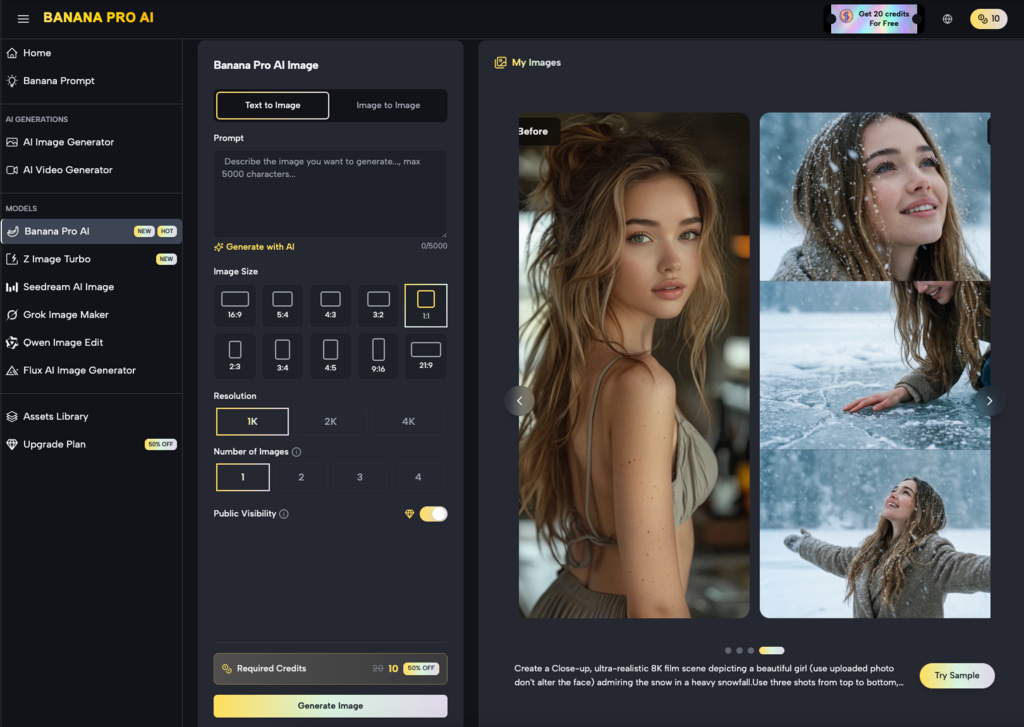
The Role of the AI Image Editor in Batch Refinement
Once a batch of images is generated, the AI Image Editor becomes the primary tool for normalization. Rather than discarding an image because the lighting is slightly off or a background element is distracting, editors can use in-painting and generative fill to harmonize the asset with the rest of the set.
In a typical agency pipeline, the workflow looks like this:
- Batch Generation:
- Culling:
- Normalization:
- Extension:
This approach treats the AI output as a "digital clay" rather than a finished photograph. It acknowledges that while Nano Banana can do the heavy lifting, the human eye is still the final arbiter of brand truth.
Scaling Consistency Across Platforms
The challenge of multi-channel scaling is that each platform has its own "visual language." A Facebook ad might need to be loud and high-contrast to stop the scroll, while a landing page image needs to be more atmospheric and supportive of text overlays.
Using the Banana AI ecosystem, teams can maintain a central "style seed." By referencing the same latent space parameters—or even using image-to-image references—operators can ensure that the core elements of the Nano Banana generation remain intact even as the composition changes.
For instance, if you are promoting a tech product, the specific "blue-hued metallic finish" of the device needs to look the same in a close-up product shot as it does in a lifestyle shot of a person using it. This is where the Banana Pro workflow shines. By locking in the material properties through reference images, you reduce the "hallucination" of the AI, ensuring that the product doesn't change its physical characteristics between frames.
Operational Hurdles and Realistic Expectations
It would be a disservice to suggest that this process is entirely seamless. One significant limitation of current AI production is typography and specific brand logos. While the visual environment generated by Nano Banana Pro might be perfect, the model will still struggle to render legible, brand-accurate text within the image.
For agencies, this means the Banana AI workflow should terminate at the "clean plate" stage. High-fidelity visuals are exported, and then typography and logos are layered on using traditional vector tools. Attempting to force the AI to handle precise kerning or logo geometry is a recipe for wasted credits and frustration. The most efficient teams use AI for the "soul" of the image and traditional design software for the "structure."
Another point of uncertainty is spatial consistency in complex scenes. If you need three characters standing in a specific formation, the AI might occasionally merge limbs or misinterpret the depth of field. In these instances, the "manual redraw" isn't a full paint-over, but a surgical fix within the editor to restore anatomical or spatial logic.
The Economic Argument for Specialized Workflows
Why bother with this level of detail? For most agencies, the pivot to using Banana Pro and dedicated editors is about the "cost per approved asset."
In a traditional photography-led workflow, the cost is front-loaded: equipment, talent, location, and post-production. If the client hates the lighting three weeks later, you're back to square one. In an AI-driven workflow, the cost is shifted toward the "refinement" stage. Because tools like Nano Banana allow for rapid iteration, the agency can present three distinct creative directions in the time it used to take to draft a single mood board.
The efficiency isn't just in the speed of generation; it's in the reduced friction of revisions. When a client asks to "make the background a bit more industrial," an editor doesn't have to reshoot. They simply mask the background in the AI editor, update the prompt, and regenerate that specific section while keeping the foreground character untouched.
From Prompt Engineering to Creative Direction
As the tools within the Banana Pro suite become more intuitive, the role of the "prompt engineer" is evolving into that of a "creative director of machines." It is no longer enough to know which keywords trigger a certain style. Operators must understand the underlying mechanics of composition, lighting, and color theory to guide the AI effectively.
A practical tip for teams using Nano Banana is to maintain a "negative prompt library." This is a list of visual elements that the brand never wants to see—certain colors, "uncanny" textures, or specific lighting styles. By applying this library across all batches, you create a safety net that keeps the output within a professional range, regardless of who is running the generation.
Final Thoughts on the Hybrid Workflow
The transition to AI-assisted asset production isn't about replacing the designer; it’s about removing the repetitive "grunt work" that leads to burnout and inconsistent quality. By utilizing Nano Banana Pro for the heavy lifting of visual creation and the associated editor for the precision work of brand alignment, agencies can finally break the bottleneck of manual production.
However, the most successful implementations are those that remain skeptical. Every batch should be audited for style drift. Every "perfect" generation should be checked for anatomical errors. The goal of the Banana AI ecosystem isn't to provide a hands-off experience, but to provide a high-leverage toolkit that responds to professional guidance.
In the end, scaling visual assets is a game of probability. The better your tools—and the more disciplined your workflow—the higher the probability that your fiftieth asset will look just as intentional and brand-aligned as your first. By moving from haphazard prompting to a structured pipeline involving Nano Banana and rigorous post-generation editing, agencies can finally deliver the scale that modern multi-channel marketing demands without sacrificing the nuance that makes a brand memorable.



의견을 남겨주세요