
If you’re diving into Microsoft Fabric or preparing for DP-600, understanding OneLake is crucial. It’s the backbone of all Fabric workloads, and getting it right can save you confusion in the exam and in real-world implementation. Let’s unpack it step by step.
Introduction to OneLake
At its core, OneLake is the unified, managed data lake of Microsoft Fabric. Think of it like a single storage home for all your analytics data, a place where every workload, from Lakehouses to Warehouses to Power BI datasets, can read and write data without duplicating it.
This is a big deal because before OneLake, data was scattered across multiple storage services: separate lakes for different teams, separate warehouses, separate Power BI datasets. OneLake solves this by providing a single source of truth.
DP-600 Connection:In the DP-600 exam, questions may ask where Fabric stores its data, or how workloads share information. The answer is almost always OneLake, because it’s mandatory and automatically managed. Candidates often trip up by thinking they need to configure ADLS or other storage manually.
Why OneLake Exists?
OneLake wasn’t created just for convenience. Its goals are:
- Eliminate duplication:
- Simplify governance:
- Enable cross-workload analytics:
- Support modern open formats:
In other words, OneLake is not just storage, it’s a design philosophy of Fabric: unify, simplify, and scale analytics.
Architecture of OneLake
Understanding the architecture is key, especially for Implementing Analytics Solutions Using Microsoft Fabric DP-600 exam candidates who might face scenario-based questions:
- Workspace as a Container:
- Workload Folders:
- Storage Backend:
- File Formats:
- Access Control:
Tip: In the exam, if a question mentions “physical storage,” “workspace,” or “shared data,” OneLake is almost always the correct reference.
How OneLake Works with Workloads?
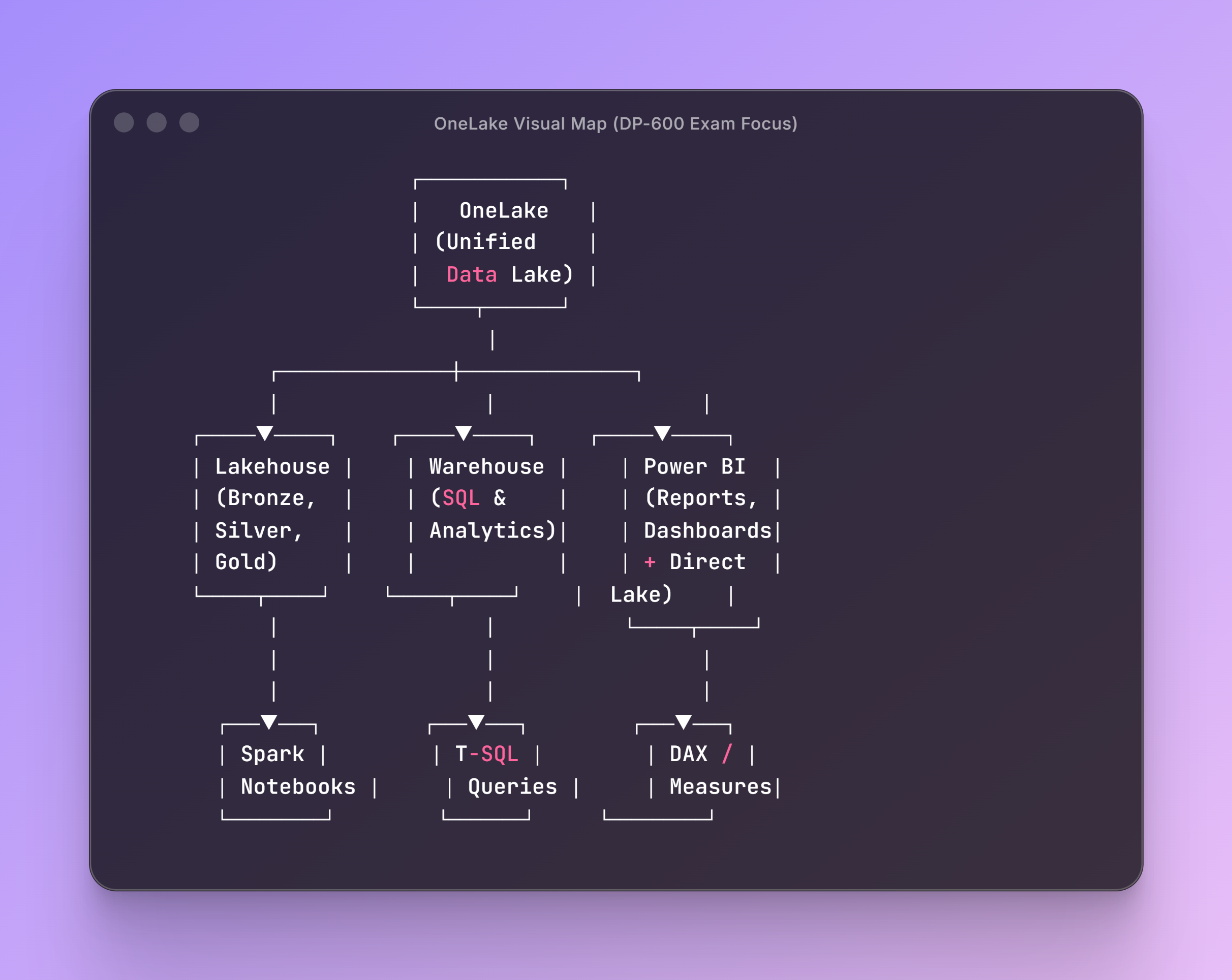
OneLake doesn’t replace Lakehouses, Warehouses, or Power BI; it underpins them. Here’s how:
- Lakehouse:
- Warehouse:
- Power BI / Direct Lake:
This unified approach also enables real-time updates and refreshes across tools, if you update a table in the Lakehouse, all workloads see it.
Security and Governance
OneLake isn’t just convenient; it’s secure:
- Role-Based Access:
- Row-Level and Object-Level Security:
- Lineage & Auditing:
- Sensitivity Labels:
DP-600 Insight: Exam questions often test your understanding of “how to enforce security in shared storage.” Remember: OneLake manages data centrally, but security is per workspace/item, not per file.
Direct Lake and OneLake
Direct Lake is a query mode in Power BI that allows semantic models to access OneLake data directly:
- No import, no duplication.
- Real-time reads of Delta tables.
- Faster performance and lower storage overhead.
Think of Direct Lake as a lens that reads OneLake data instead of copying it into Power BI.
Common Concerns of Candidates
Candidates preparing for DP-600 often have the following questions:
- Do I need to create or manage OneLake?
- Is it the same as ADLS Gen2?
- Can multiple teams overwrite each other’s data?
- Does OneLake replace the Warehouse?
- Is it optional?
- How about costs?
These concerns are exactly what Microsoft tests indirectly in scenario-based questions.
Many DP-600 candidates practice scenario-based questions from various sources to test their understanding of OneLake. Platforms like Pass4Future provide DP–600 practice questions that help learners see how Microsoft frames exam scenarios around concepts like OneLake, Lakehouse, and Direct Lake.
OneLake in Real-Life Analytics
Beyond exams, OneLake simplifies day-to-day analytics:
- Analysts no longer spend hours copying datasets.
- Data engineers can centralize pipelines without worrying about duplication.
- IT teams can enforce compliance across all workloads without complex scripts.
- Developers can run Spark jobs, SQL queries, and Power BI reports on the
In short, it makes Fabric a true unified analytics platform.
Exam Tip (Remember Once, Like a Magic Sentence)
If a DP-600 question asks where Fabric workloads store data, or how multiple workloads share data, the answer is always OneLake, automatically managed, unified, and secure.
Keep this in your mind while studying; the rest of the OneLake details are about how and why it works, which can help you answer scenario-based questions confidently.
Final Verdicts
OneLake in Microsoft Fabric is the powerhouse behind all Fabric workloads, acting as a centralized data hub for Lakehouses, Warehouses, and Power BI. It crushes data duplication, streamlines governance, and unlocks cross-workload intelligence with open formats like Delta and Parquet. Workspaces become smart containers, folders organize workloads, and ADLS Gen2 powers storage invisibly. Security is tight yet flexible, with role, row, and object-level controls integrated via Microsoft Purview. Direct Lake lets Power BI tap data instantly without extra copies. OneLake is non-negotiable, auto-managed, and essential for both DP-600 success and smooth, modern analytics in the real world.



의견을 남겨주세요