
Can Srimad Bhagavatam Help With Anxiety and Mental Suffering? Here's What It Says
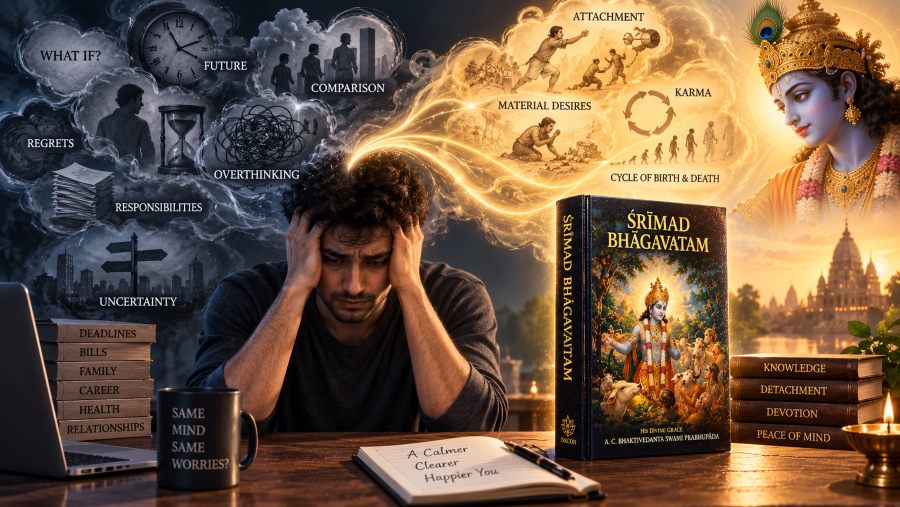
At some point, almost everyone lies awake at 3 a.m. running the same loop — a conversation replayed for the tenth time, a worry about something that hasn't happened yet, a low hum of dread with no clear source. You reach for whatever's supposed to help: breathing apps, distraction, sometimes just waiting it out. Rarely does anyone reach for an eighteen-thousand-verse text composed thousands of years ago. And yet Srimad Bhagavatam spends enormous energy on exactly this question — not anxiety in the clinical sense doctors diagnose today, but the deeper mechanism of mental suffering that anxiety is usually one expression of. Readers who've spent time with a full set from the ISKCON Bhagavatam collection tend to be surprised by how directly the text engages this, less like a sermon and more like someone patiently explaining why your mind keeps doing the thing it does. Worth saying upfront: this isn't a substitute for therapy or medical care when anxiety is severe or persistent — it's a different lens, one worth having alongside proper clinical support, not instead of it.
The Question Everyone Skips: What Is Anxiety Actually About?
Modern approaches to anxiety tend to focus on the trigger and the symptom — a racing heart, a spiraling thought, a specific fear. Srimad Bhagavatam asks a more uncomfortable question underneath all of that: why does the mind default to threat-scanning in the first place, even when nothing threatening is actually happening?
Its answer, developed mainly across Canto 3 and Canto 11, is that most mental suffering traces back to one root condition — identifying yourself with things that are inherently unstable. Your body changes constantly and will eventually fail. Your circumstances shift without asking permission. Relationships, income, health, reputation — all of it moves, all the time. If your sense of "I am okay" is wired directly into any of those moving parts, you're constructing a nervous system that has to stay on alert permanently, because the ground it's standing on never actually stops shifting.
This isn't a dismissal of anxiety as somehow fake or self-inflicted. It's a specific diagnosis: not "you're anxious because you're weak," but "you're anxious because the target you've attached your sense of safety to was never going to hold still." That reframe matters, because it changes where you look for a fix.
Why Fighting a Thought Directly Rarely Works
Anyone who's tried to talk themselves out of an anxious spiral already knows the frustrating truth: rational argument barely touches it. You can list every reason the worry is irrational, and the anxious loop keeps running anyway, apparently unbothered by your logic.
Srimad Bhagavatam has a structural explanation for why this happens. The mind, in its model, isn't a reasoning organ — it's closer to a fast pattern-matcher, constantly tagging incoming information based on accumulated past experience, firing reactions before your slower, more deliberate intelligence gets a chance to weigh in. By the time you consciously notice the worry and try to reason with it, the reactive process has already fired, and reasoning after the fact is a bit like trying to un-ring a bell.
What this explains about the anxiety loop:
- Why you can know intellectually that a fear is irrational and still feel it fully in the body
- Why willpower alone rarely resolves a recurring anxious pattern
- Why the same trigger keeps producing the same spiral, no matter how many times you've consciously decided to stop reacting that way
The text's implication is blunt: if you're only working at the level of conscious argument, you're addressing the wrong layer of the system. The reactive mind needs to be retrained, not out-argued.
The Three States Your Mind Cycles Through (And Why One of Them Is Basically Anxiety's Home Turf)
Srimad Bhagavatam describes three underlying qualities, or gunas, that shape every mental state a person moves through — sattva (clarity), rajas (agitation, restless energy), and tamas (heaviness, inertia). Almost nobody lives permanently in one; you cycle through all three depending on what's feeding your mind at any given moment.
Anxiety, in this framework, is largely a rajasic phenomenon. Rajas produces high mental activity, but scattered and reactive rather than clear — a huge amount of internal motion generating very little actual resolution. It's the mental equivalent of spinning your wheels in mud: plenty of effort, plenty of noise, but the situation doesn't actually move.
Here's why this framing is useful practically: it suggests anxiety isn't a fixed trait you either have or don't have. It's a state, heavily influenced by inputs — what you consume, how you spend your attention, what kind of company and environment you keep. The text spends a surprising amount of time on this, treating diet, sleep, sensory input, and company as direct levers on which guna dominates, rather than treating the mind as an isolated system that operates independently of everything feeding into it.
The Deeper Layer: Suffering That Isn't Really About the Thing You Think It's About
One of Srimad Bhagavatam's sharper observations is that most specific worries are stand-ins for one underlying fear that rarely gets named directly — the fear of loss, in its most general form. Loss of control, loss of approval, loss of identity, ultimately loss of life itself. The text argues that almost every anxious spiral, traced back far enough, connects to this same root, even when the surface-level trigger looks completely unrelated.
This matters because it explains a pattern a lot of people notice but rarely articulate: solving one specific worry rarely brings lasting relief, because another one shows up shortly after to take its place. If the anxiety were really about the specific trigger, resolving the trigger should end it. When it doesn't — when the mind just finds a new object to fixate on — that's fairly strong evidence the actual engine was never really about that particular thing.
Srimad Bhagavatam's response to this isn't to tell you to stop caring about outcomes. It's more precise than that: hold outcomes with open hands rather than a closed fist. Engage fully, care genuinely, but stop making your internal stability contingent on how any particular situation resolves. That's a subtle shift, and it's genuinely hard to practice, but it's different from either forced detachment or anxious overinvestment — it's a third option most self-help frameworks don't clearly name.
A Practical Difference: Redirection Instead of Suppression
Here's where the text's approach differs meaningfully from "just don't think about it," which is famously bad advice that tends to backfire. Srimad Bhagavatam is explicit that suppressing a thought just builds pressure that surfaces later, often worse. Its actual method is redirection — giving the mind something more absorbing to hold onto, rather than fighting it into silence.
The logic runs roughly like this:
- The anxious mind needs an object to fixate on; it rarely just goes quiet on command
- Fighting the object directly (suppression) tends to strengthen its grip
- Replacing the object with something genuinely more engaging naturally loosens the original fixation, the same way a completely absorbing task makes you forget to check your phone without any willpower involved
The text's specific recommendation is devotional focus — chanting, meditation on something beyond the immediately personal, structured practice repeated consistently enough that it becomes the mind's default resting point instead of the anxious loop. You don't need to share the theology to test the underlying mechanism: give the mind a genuinely engaging, repeatable anchor, and watch whether the anxious spiral loses some of its grip simply because attention is a limited resource and it's now spent elsewhere.
If you want to trace exactly how the text builds this argument, including the specific practices it recommends and the reasoning behind each one, it's worth sitting with the actual ISKCON Srimad Bhagavatam Book directly rather than a condensed summary, since the argument develops gradually across multiple cantos and loses a lot of its internal logic when compressed.
What the Text Doesn't Promise (And Why That's Actually Reassuring)
Srimad Bhagavatam never claims that following its method eliminates anxiety instantly or permanently on the first attempt. If anything, it's unusually honest about backsliding — full of stories about serious practitioners who lose their footing and have to start again. That's a healthier model than the quick-fix framing a lot of modern content pushes, because it removes the shame spiral that shows up when a technique doesn't work immediately. Progress here is treated as gradual retraining, not a switch you flip once.
It's also worth being clear about what this framework isn't. It isn't a replacement for treating clinical anxiety disorders, trauma responses, or conditions that need professional evaluation and, often, medical treatment. What it offers is a different layer — a way of understanding the mechanism underneath anxious thought patterns, and a set of practices aimed at that mechanism rather than just the surface symptom. For a lot of people, that layer sits usefully alongside proper clinical support rather than competing with it.
The Honest Takeaway
Srimad Bhagavatam's real claim isn't that spiritual practice makes life's uncertainty disappear. Loss still happens. Change still happens. What the text argues is that your suffering isn't actually proportional to how much uncertainty exists in your life — it's proportional to how tightly your sense of self is wired into things that were never built to hold still. Loosen that wiring, even slightly, and the same uncertain world somehow becomes something you can stand inside of without your whole nervous system treating it as an emergency. That's not a cure. It's a genuinely different relationship to the thing that was never going away in the first place.
A note if you're reading this in the middle of a hard time: if anxiety is affecting your daily life, sleep, or safety, please reach out to a mental health professional — this kind of philosophical framework works best as a companion to proper care, not a substitute for it.



의견을 남겨주세요