
By Meka Coven
Choosing between ChatGPT and Claude is easy if you only read the first answer. The harder part starts when both answers look plausible. A different prompt, missing file, or extra follow-up can make a side-by-side test unfair before you notice.
Use a task from your own work instead. Keep the inputs fixed, decide what you will check, and choose the response you can use after that check. The goal is not a permanent winner. It is a fairer answer to a smaller question: which response fits this job?
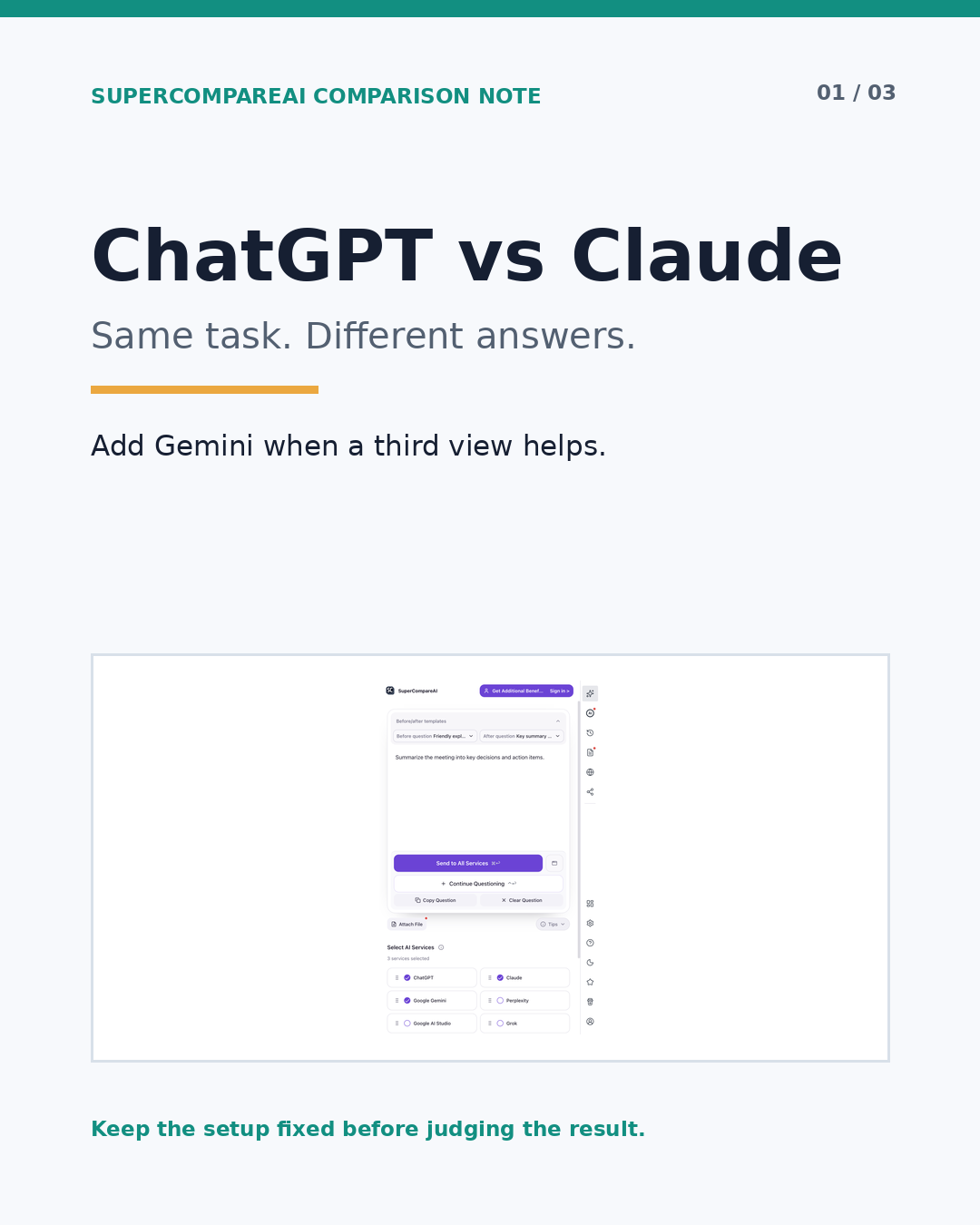
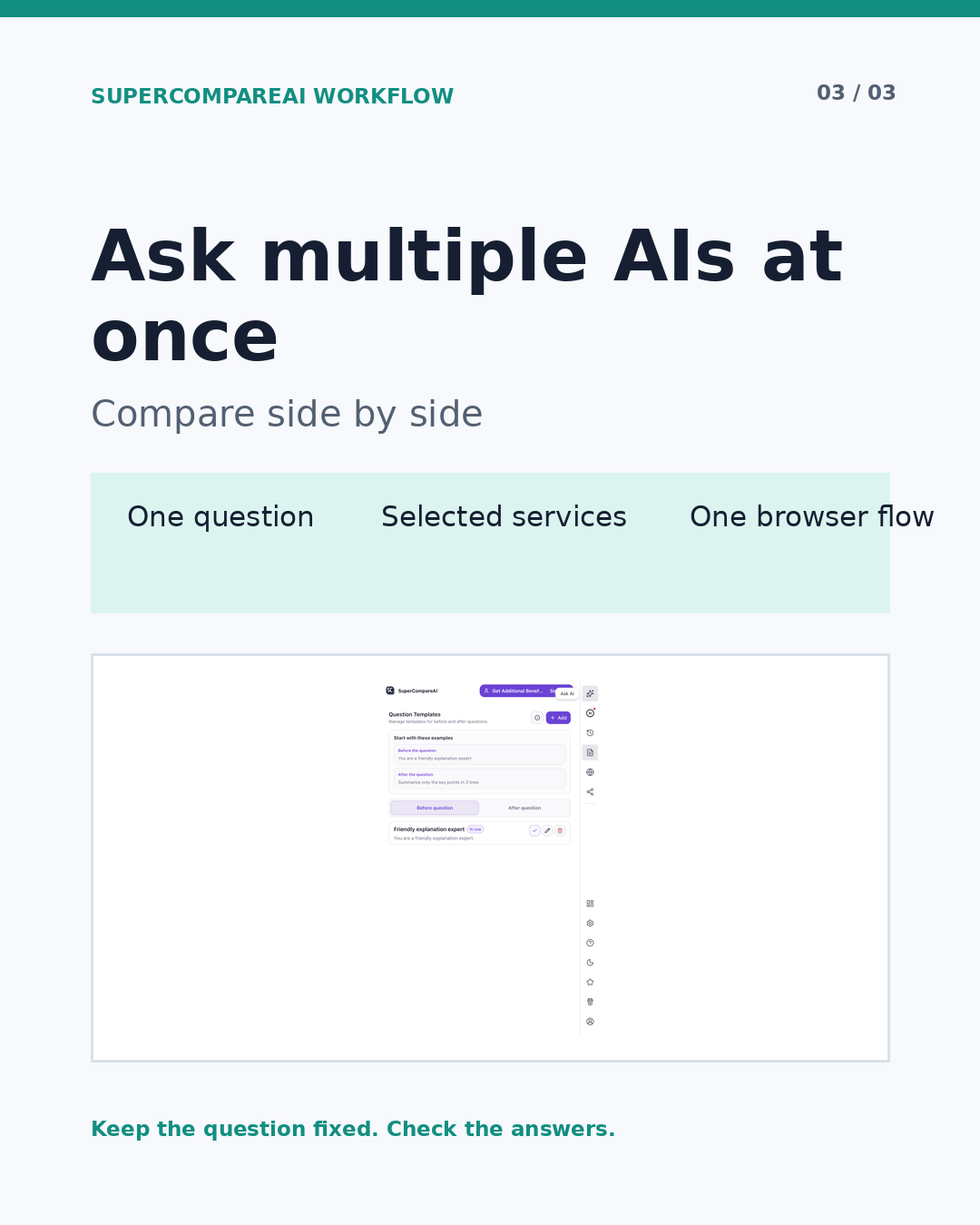
SuperCompareAI lets you send one question to selected AI services in one browser flow. That makes it easier to ask multiple AI models at once while keeping the setup consistent.
• Introduce: https://www.supercompareai.com/
• Chrome extension: https://chromewebstore.google.com/detail/supercompareai-compare-ch/fhbnhohjeakmodifnnmpmphacbnolfhf
Start with the decision, not the model
Pick a task with a visible finish line: a short planning memo, a code review, a research outline, or a rewrite for a specific audience. A clever puzzle may produce a memorable answer, but it tells you little about work you actually need to finish.
Before you compare anything, write down:
• What the answer must help you decide or deliver
• Which facts, files, links, and examples every service may use
• The audience, format, length, and hard limits
• Which claims need a source or a separate check
• What a wrong answer would look like for this task
Then make one prompt you can reuse:
Prompt example
I need to [specific task] for [audience]. Use only the context below. Give me one recommendation, list the assumptions behind it, identify two risks, and mark any claim I should verify.
Send the same prompt, context, and files to ChatGPT and Claude. Add Gemini as a third comparison when it answers a question you genuinely have, not just to make the test look bigger. Record the service names and the input each one received. If a service handles a file or link differently, note that difference instead of quietly changing the test.
Score the response you can use
Read the answers once without picking a favorite. On the second pass, check the parts that can change your next action:
• Did the response follow the requested format and limits?
• Did it use the supplied context, or fall back to generic advice?
• Which claims and assumptions still need checking?
• Can you act on the recommendation without filling in missing pieces?
• Did it show uncertainty where uncertainty mattered?
• What changed after the same follow-up question?
A confident sentence is not evidence. Agreement is not proof either. One answer may feel better because it is direct, while another makes a risk visible. For a work decision, check which claims survive a separate review.
SuperCompareAI is a Chrome extension that sends one question to selected AI services and compares their answers in one browser flow. Its official pages list 12 services: ChatGPT, Claude, Gemini, Perplexity, Google AI Studio, Grok, GenSpark, Qwen, DeepSeek, Copilot, Z.ai, and Kimi. The same pages describe using existing AI accounts without provider API keys, browser-side operation, local browser history, question templates, custom sites, and file or image attachments. These are product facts, not a verdict about any model's answer.
If you want to compare multiple AI models simultaneously without rebuilding the same prompt in several tabs, the extension keeps the repeated dispatch step in one workflow while you do the checking.
• Introduce: https://www.supercompareai.com/
• Chrome extension: https://chromewebstore.google.com/detail/supercompareai-compare-ch/fhbnhohjeakmodifnnmpmphacbnolfhf
Run one shared follow-up
The first answer often hides an assumption. Ask ChatGPT, Claude, and Gemini the same second question instead of repairing only the response you liked less:
Prompt example
Review your previous answer. Name one assumption that could fail, one claim I should verify, and one detail you would change for [audience].
Compare the revisions as carefully as the first answers. Did a service notice a real gap? Did it change a recommendation without explaining why? Did it ask for information the original prompt did not provide?
Do this before one answer influences how you read the others. Once you paste one model's response into another, you are testing synthesis rather than the original side-by-side question.
Keep a small test note
The extension sending one question to selected AI services is an observed product fact from the official pages. Which answer worked better for your task is your test result. It depends on the prompt, context, checks, and notes you kept.
After each run, record:
• The exact prompt and its version
• The services, files, links, and context supplied
• Claims that still need verification
• The answer or section you used
• What changed after the shared follow-up
• Why the result fits, or does not fit, this task
That note keeps one impressive response from turning into a permanent label. A different audience or source document can change the result, and that is useful information about the work.
Choose after the check
ChatGPT vs Claude is a useful starting pair, not a permanent verdict. Gemini can add a third view when the task benefits from it. Keep the conditions visible, check the claims, and choose the response that holds up for the job in front of you.
SuperCompareAI can handle the repeated question-and-dispatch step, so you can spend the time comparing evidence and deciding what to use. You still decide what to trust after reviewing the answer.
• Introduce: https://www.supercompareai.com/
• Chrome extension: https://chromewebstore.google.com/detail/supercompareai-compare-ch/fhbnhohjeakmodifnnmpmphacbnolfhf
Written by Meka Coven.