
By Meka Coven
ChatGPT and Claude can both give you a polished answer in seconds. That makes a quick comparison surprisingly unreliable. If you change the prompt, context, or follow-up between tabs, you may be comparing your setup more than the models.
Use a task you actually need to finish. Give ChatGPT and Claude the same question, background, source rules, and output format. If the decision matters, add Gemini as a third view. The point is not to crown a permanent winner. It is to see which answer holds up under the same conditions.
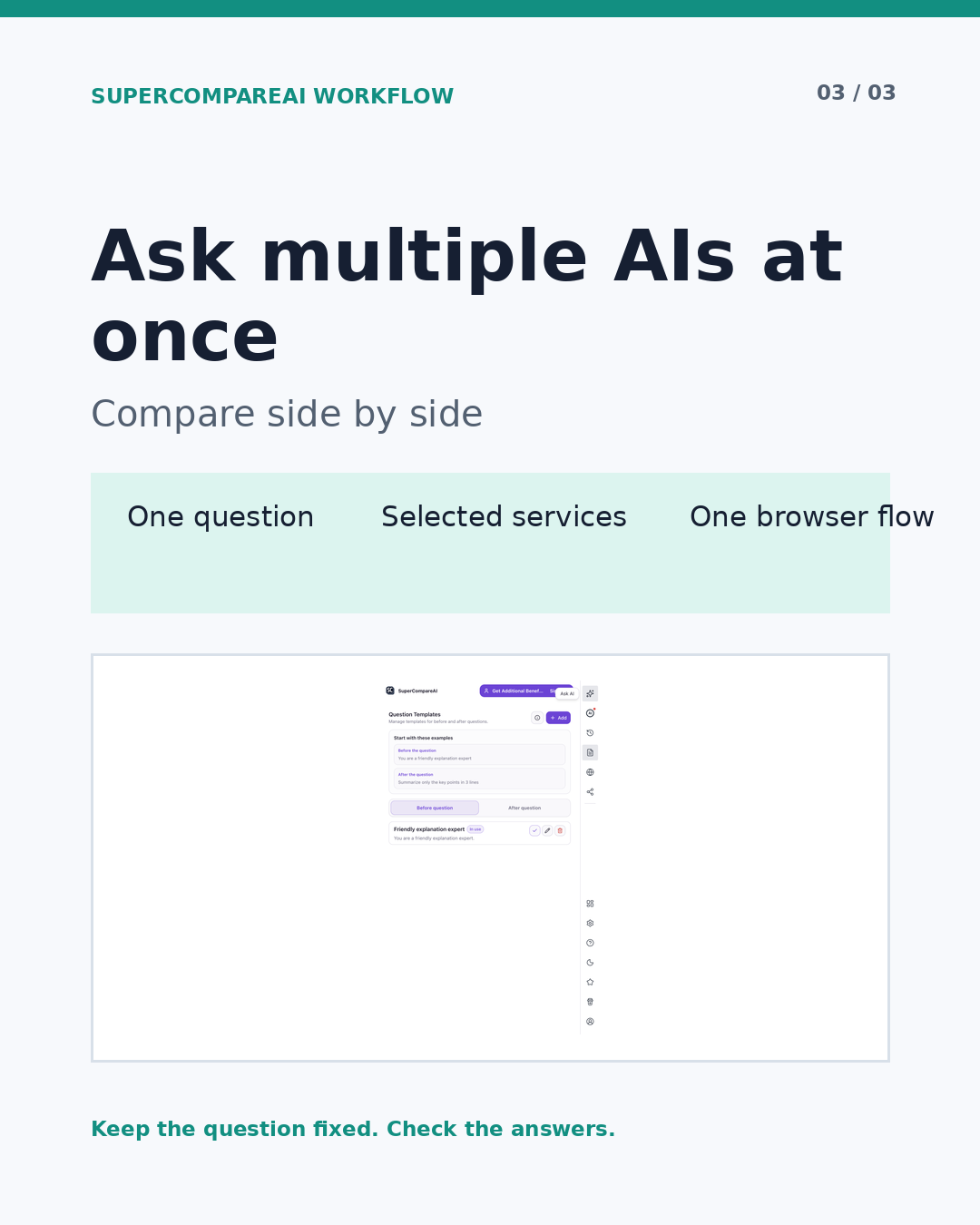
SuperCompareAI sends one question to selected AI services in one browser flow. It is useful when you want to ask multiple AI models at once without rebuilding the same prompt in several tabs.
• Introduce: https://www.supercompareai.com/
• Chrome extension: https://chromewebstore.google.com/detail/supercompareai-compare-ch/fhbnhohjeakmodifnnmpmphacbnolfhf
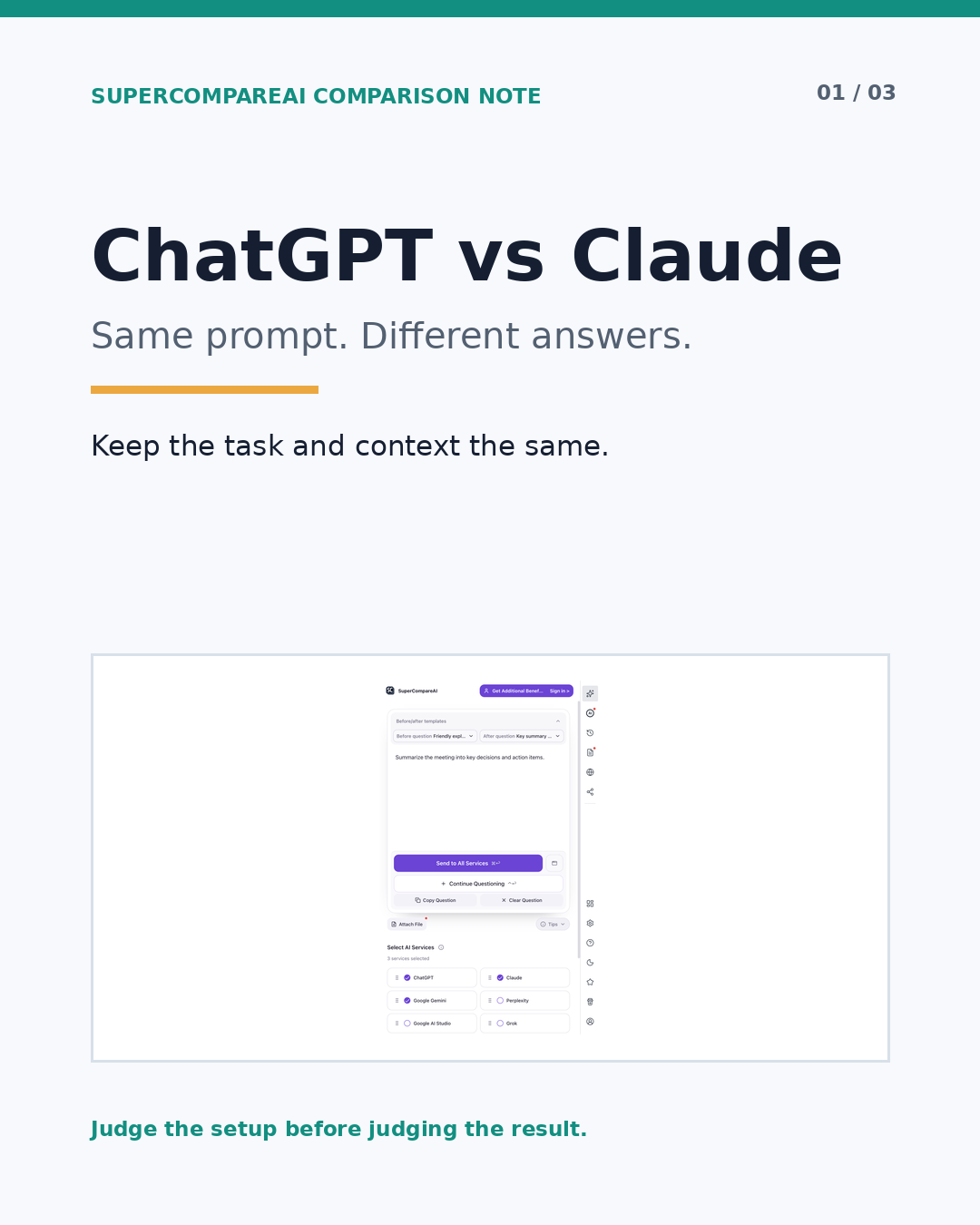
Build a prompt you can reuse
A fair ChatGPT vs Claude test starts with a fixed question. Write down the finish line before you open either service:
• The decision or piece of work the answer should support
• The context, files, links, and date range both services may use
• The output format, length, audience, and hard limits
• The evidence you expect, such as source links, quotations, or a clear uncertainty note
• The condition that would make an answer unusable
For example:
Prompt example
I need a short brief for a product decision. Use only the notes and links below. Separate verified facts from suggestions, cite the source for each important claim, stay within 500 words, and mark anything I should check before using it.
Send that exact prompt to ChatGPT and Claude. Add Gemini when a third answer would help you spot an assumption. Do not improve one service's prompt after seeing the other response. That changes the experiment.
Compare the work behind the answer
Read the first responses once without picking a favorite. Then check the same points in both:
• Did the service answer the question you actually asked?
• Are important claims tied to relevant evidence?
• Does it separate facts, suggestions, and uncertainty?
• Did it follow the date range, format, and length limit?
• Can you identify one claim that needs an independent check?
• Would the answer help you take the next step, or only sound complete?
This is where a side by side comparison becomes useful. A shorter answer may be easier to use. A longer one may leave a better trail for checking. Neither pattern proves that ChatGPT or Claude is always better. Record what happened on this task instead of turning one result into a permanent label.
The official SuperCompareAI pages describe a Chrome extension that sends one question to selected AI services and compares their answers in one browser flow. The official product pages currently list 12 selectable services: ChatGPT, Claude, Gemini, Perplexity, Google AI Studio, Grok, GenSpark, Qwen, DeepSeek, Copilot, Z.ai, and Kimi. They also describe using existing AI accounts without provider API keys, browser side operation, local browser history, question templates, custom sites, and file or image attachments. Those are product facts. They do not decide which service will work better for your particular task.
An AI comparison tool can handle the repeated dispatch step and keep multiple AI models side by side. You still need to inspect the sources and make the call.
• Introduce: https://www.supercompareai.com/
• Chrome extension: https://chromewebstore.google.com/detail/supercompareai-compare-ch/fhbnhohjeakmodifnnmpmphacbnolfhf
Give every model the same follow-up
The first response often hides an assumption. Use one shared follow-up rather than repairing only the answer you like less:
Prompt example
Recheck your previous answer. List the three claims that matter most for my decision, give the source or reason for each, and mark the point most likely to be wrong.
Send that follow-up to ChatGPT and Claude. If you added Gemini, send it there too. Compare what changed:
• Did the service correct a real gap?
• Did it change a claim without explaining why?
• Did it ask for information that the first prompt did not provide?
• Did the new version become more cautious without becoming more useful?
Do the shared follow-up before one response changes how you read the others. Pasting Claude's answer into ChatGPT tests a combined workflow, not the original comparison.
Keep a small test note
Separate observed product facts from your own result. The extension's one question dispatch and comparison flow are facts described by the official product pages. Which response helped more is your result, and it depends on the task and the conditions you kept fixed.
After each run, save:
• The exact prompt and version
• The services and supplied context
• Claims that still need checking
• The answer or section you used
• What changed after the shared follow-up
• Why the result fits, or does not fit, this task
That note stops one impressive response from becoming a rule. A different source document or a clearer output requirement can change the result. That is not a problem; it is the information your comparison was meant to reveal.
Choose after the check
ChatGPT vs Claude is a useful starting point, not a permanent verdict. If neither answer meets your evidence rule, revise the task or add Gemini as a third comparison view. Choose the response that survives your checks and fits the work in front of you.
SuperCompareAI can take care of the repeated question and dispatch step, leaving you with the part that still needs judgment: comparing the evidence and deciding what to use.
• Introduce: https://www.supercompareai.com/
• Chrome extension: https://chromewebstore.google.com/detail/supercompareai-compare-ch/fhbnhohjeakmodifnnmpmphacbnolfhf
Written by Meka Coven.