
As industries increasingly demand smarter and more reliable human-machine interfaces (HMI), the importance of custom touch screen displays has grown rapidly.
Whether it’s for factory automation, medical diagnostics, outdoor kiosks, or smart home devices, tailored touch solutions can determine a product’s success in both functionality and user experience.
This article explains how capacitive touch screen customization—including FPC design, cover glass engineering, bonding technology, and surface treatment—enables high-performance, application-specific display solutions.
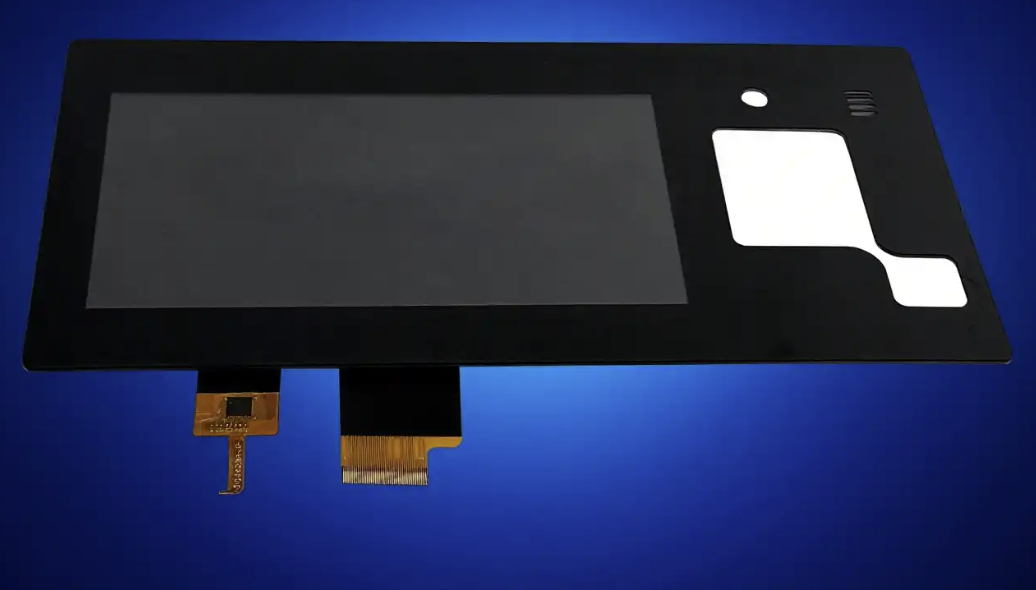
Why Custom Touch Screen Displays Matter
The Shift Toward Application-Driven Design
Off-the-shelf display modules often fail to meet the mechanical, optical, or environmental requirements of industrial projects.
Manufacturers increasingly turn to custom displays that are purpose-built for harsh environments, unique enclosures, or distinctive user interfaces.
For example:
- Rugged tablets in transportation and logistics
- Touch panels in medical analyzers
- Outdoor payment terminals exposed to sunlight and rain
- Compact smart home controllers with elegant UI layouts
A standard touch module can’t always satisfy such varied needs—customization ensures the display precisely fits the intended environment.
Advantages of Custom Capacitive Touch Screens
Customized capacitive touch panels provide tangible benefits:
- Design flexibility
- Enhanced durability
- Superior visual performance
- Consistent branding
These advantages make custom capacitive touch screens an ideal choice for industrial displays, medical instruments, and consumer-grade smart devices alike.
FPC Design: The Hidden Backbone of Integration
Custom Shape and Connector Options
The FPC (Flexible Printed Circuit) connects the touch sensor to the main system board.
In custom designs, the FPC layout can be tailored to fit space constraints or improve reliability:
- Irregular FPC outlines for compact housings
- Customized pin definitions to match the control board
- Relocated connectors for easier assembly
- Support for multiple interface types (I²C, USB, SPI)
This flexibility allows engineers to integrate the touchscreen seamlessly into mechanical structures without redesigning the entire system.
IC Compatibility and Multi-OS Support
A crucial step in customization is selecting the right touch controller IC.
Depending on performance and feature needs, designers may choose from controllers supporting:
- Waterproof operation
- Glove and stylus modes
- Multi-touch gesture recognition
Compatibility with Android, Linux, and Windows systems ensures software development remains straightforward.
Cover Lens Customization: The Face of the Product
Tailored Dimensions and Thickness
Custom displays are available in a wide range of sizes—from 1.3-inch handheld modules to 15.6-inch control panels and beyond.
Glass thickness can vary from 0.7 mm to 6 mm, depending on whether optical sensitivity or mechanical strength is prioritized.
- Thin glass suits compact consumer devices
- Thick, reinforced glass ensures safety and longevity in industrial environments
Irregular Shapes and Functional Cutouts
Modern products rarely stick to rectangular screens.
To match complex industrial or consumer designs, cover lenses can include rounded edges, notches, or cut-through holes for sensors, cameras, or LEDs.
These modifications allow integration of additional hardware without compromising the user interface.
Printing and Branding Options
Logo, border, or icon printing directly on the glass enhances visual clarity and brand identity.
Silkscreen or UV printing processes enable durable, high-contrast markings that remain stable even in outdoor or high-temperature applications.
High-Strength Glass Materials
For demanding use cases, chemically strengthened glass such as Gorilla Glass or Dragontrail provides outstanding resistance to scratches and impacts.
These materials also maintain superior optical clarity—critical for medical and high-precision equipment.
Surface Treatments That Improve Durability and Visibility
Touchscreen performance goes beyond electronics—the surface coating plays a major role in real-world usability.
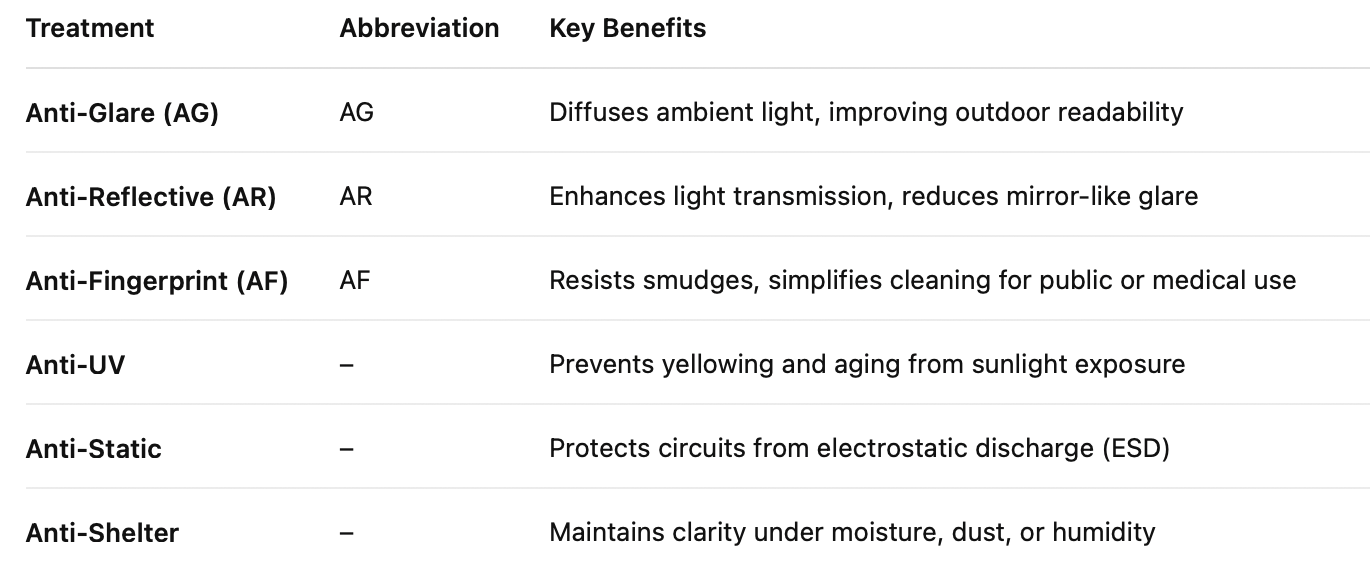
Each treatment can be combined to match environmental requirements—for instance, AR + AF coatings for medical equipment, or AG + Anti-UV for outdoor kiosks.
Bonding Technologies: Connecting Display and Touch Layers
The bonding process between the display and touch sensor determines optical performance and durability.
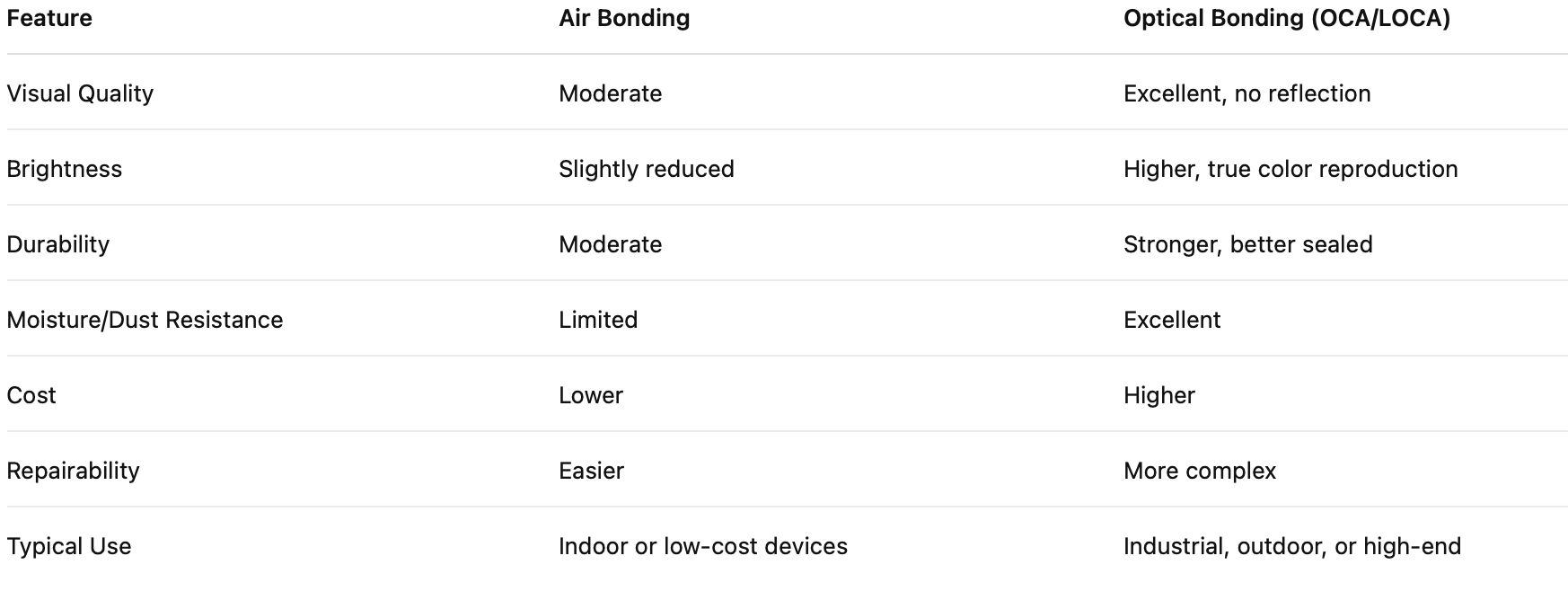
Three major techniques dominate the market: Air Bonding, OCA Bonding, and LOCA Bonding.
Air Bonding
A thin air gap separates the layers.
This is the most cost-effective method but has limitations: lower contrast, visible reflections, and weaker resistance to vibration or humidity.
Best suited for budget or indoor applications.
OCA (Optically Clear Adhesive) Bonding
An adhesive film fills the space between the touch panel and the display.
This eliminates internal reflections and improves contrast and visibility.
OCA also seals the module against dust and moisture—ideal for industrial control panels and commercial touchscreens.
LOCA (Liquid Optically Clear Adhesive) Bonding
LOCA uses a UV-curable liquid adhesive that completely fills all microscopic gaps.
It delivers the best optical quality, highest impact resistance, and compatibility with curved surfaces.
Used in premium products and high-end industrial or automotive HMIs.
Comparison Overview
Application Examples
1. Medical Equipment
Medical displays prioritize hygiene, clarity, and precision.
Custom touch panels for these devices often include:
- Optical bonding for maximum transparency
- Anti-fingerprint and anti-reflective coatings
- Glove-compatible capacitive touch operation
- Printed icons or UI indicators for intuitive interaction
2. Industrial HMIs
In factory automation and control systems, reliability outweighs aesthetics.
Displays typically feature:
- Thick reinforced glass (up to 6 mm)
- Anti-glare and anti-static coatings
- High ESD protection
- Custom FPC routing for space-constrained installations
3. Smart Home Interfaces
For smart thermostats, appliance panels, or wall-mounted controllers, design aesthetics take center stage.
Manufacturers use:
- Slim glass with printed logos or icons
- Irregular shapes such as circular or oval displays
- Multi-touch panels supporting smooth gesture control
4. Outdoor Kiosks and Vending Machines
Outdoor displays face sunlight, rain, and temperature variations.
Effective customization includes:
- Optical bonding for enhanced sunlight readability
- Anti-UV coatings to prevent color degradation
- Waterproof and dustproof structures (IP65 or above)
- Touch ICs capable of recognizing input through gloves or water droplets
The Value of Customization
Investing in a custom touch screen display is not merely about aesthetics—it’s about optimizing functionality, durability, and usability.
Through careful selection of materials, coatings, bonding techniques, and electronic components, designers can ensure their display solutions perform reliably in even the toughest environments.
Custom touch solutions empower product developers to:
- Reduce integration challenges
- Achieve consistent user experiences
- Differentiate products in competitive markets
Final Thoughts
In today’s interconnected world, touch interfaces define how users experience technology.
A well-engineered custom display not only enhances reliability but also communicates brand quality through every interaction.
By tailoring each aspect—from FPC layout and bonding method to optical coating—manufacturers can create display solutions that meet exact performance goals for industrial, medical, and consumer applications alike.



의견을 남겨주세요