
A display described as having “Gorilla Glass” sounds straightforward. Most people associate the name with smartphones and assume it means the screen will resist scratches, survive drops, and remain attractive after years of use.
From an engineering perspective, the situation is more complicated.
Gorilla Glass is the protective cover at the front of a display assembly. It is not the LCD, OLED panel, or touch sensor itself. Its actual performance depends on how the glass is cut, strengthened, coated, bonded, and supported by the enclosure. A high-quality cover glass can still fail prematurely if its edge touches a metal bracket or if assembly screws apply uneven pressure.
This distinction matters in industrial terminals, medical equipment, outdoor kiosks, vehicle displays, and other embedded products. In these applications, the display may face vibration, cleaning chemicals, gloved operation, direct sunlight, or thousands of touches every day.
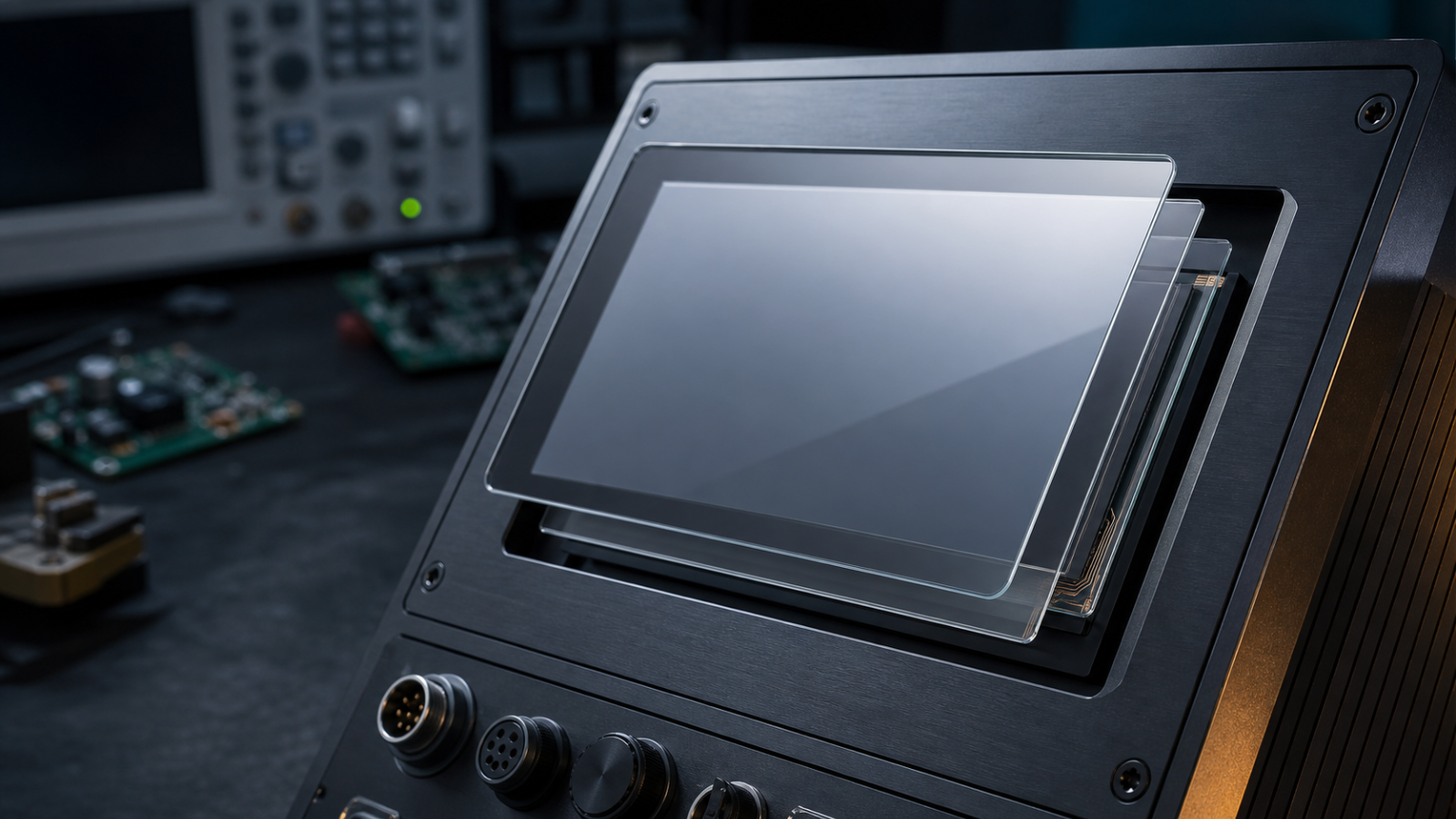
What Is a Gorilla Glass Display?
Gorilla Glass is a family of chemically strengthened glass products developed by Corning. When manufacturers use the expression “Gorilla Glass display,” they normally mean a display module protected by a Gorilla Glass cover lens.
A typical touch-display assembly contains several layers:
| Layer | Main purpose | Engineering concern |
|---|---|---|
| Cover glass | Protects the display from impact, scratches, and contamination | Thickness, edge quality, openings, and surface treatment |
| Decorative printing | Hides inactive areas and creates the front-panel appearance | Ink adhesion, color consistency, and dimensional tolerance |
| Touch sensor | Detects fingers, gloves, or stylus input | Sensitivity, controller tuning, and electrical noise |
| Optical adhesive | Joins layers and reduces internal reflection | Bubbles, yellowing, delamination, and rework |
| LCD or OLED | Produces the visible image | Brightness, viewing angle, temperature range, and lifetime |
| Backlight | Illuminates an LCD | Heat, power consumption, dimming, and brightness decay |
Several touch constructions are available. In some modules, the sensor is laminated directly beneath the cover. In others, touch electrodes are integrated more closely with the display panel. These arrangements influence thickness, optical performance, repair cost, and touch behavior.
Consequently, specifying “Gorilla Glass” does not define a complete display. The drawing should also identify the glass grade, thickness, dimensions, edge finish, coatings, printed border, adhesive system, and touch-panel construction.
How Chemical Strengthening Works
Glass is relatively strong under compression but vulnerable to tensile stress, especially when its surface contains a scratch or microscopic crack. Chemical strengthening is used to create a compressive layer near the surface.
During the strengthening process, smaller ions in the glass are exchanged for larger ions from a controlled chemical bath. The larger ions occupy more space, producing residual compression at the surface. An external force must first overcome this compression before a crack can open and propagate.
This process makes it possible to manufacture cover glass that is both thin and mechanically durable. That combination is valuable in portable products, but it is also useful in embedded equipment where weight, touch sensitivity, and optical clarity matter.
Chemical strengthening does not make glass unbreakable. A sufficiently deep scratch can penetrate the protective surface region and create a fracture point. Corners, machined holes, and exposed edges remain particularly sensitive because stress tends to concentrate there.
For that reason, phrases such as “scratch-proof” or “shatter-proof” should be avoided in technical documentation. Chemically strengthened glass is better described as more resistant to damage than comparable untreated glass.
Thickness Is a System Decision
It is tempting to increase cover-glass thickness whenever more strength is required. A thicker sheet generally offers greater resistance to bending, but it also changes other parts of the design.
Additional thickness increases weight and may require a deeper bezel or different bonding stack. More importantly, it increases the distance between the operator’s finger and the capacitive touch electrodes.
A well-designed touch controller can often work through relatively thick glass, but the system requires tuning. The challenge becomes more significant when users wear gloves or when the screen must operate in rain. Increasing touch sensitivity too aggressively may cause the controller to react to display noise, power-supply interference, or water droplets.
Thin glass can provide better touch response and lower weight. It can still be reliable if the enclosure supports it correctly. Large displays, however, may flex when pressed near the center. Engineers should evaluate glass thickness together with screen size, mounting method, expected force, and impact requirements.
There is no universally correct thickness. A handheld terminal and a fixed control-panel display may need completely different constructions despite having the same diagonal screen size.
Edge Quality Often Determines Failure
The center of a glass sheet receives most of the attention during appearance inspection, but fractures frequently begin at an edge.
Cutting and grinding can leave chips or microscopic cracks. If tensile stress reaches one of these defects, the damage may grow across the panel. Edge grinding, corner radii, chamfer dimensions, and polishing quality should therefore be defined on the mechanical drawing.
Openings need similar care. Cameras, speakers, indicators, and physical buttons may require holes or slots in the cover lens. An opening placed too close to the outer edge leaves a narrow glass section that is difficult to strengthen reliably.
Prototype glass may also differ from production glass. Small batches are sometimes manufactured with different equipment or more manual attention than high-volume parts. Edge quality should be checked again when the production process and tooling are introduced.
Choosing Surface Treatments
Cover glass can receive several optional treatments. The correct choice depends on the lighting environment and how the equipment will be used.
Anti-reflective treatment
An anti-reflective, or AR, coating reduces the amount of light reflected from the glass surface. It can improve contrast in bright rooms and outdoor environments. Coating color, abrasion resistance, and cleaning durability should be evaluated because AR layers can produce a slight visible tint.
Anti-glare treatment
Anti-glare, or AG, treatment scatters reflected light so that lamps and windows are less clearly mirrored on the screen. Strong AG treatment may introduce visible grain or reduce the sharpness of small text. High-resolution displays are particularly sensitive to this effect.
Anti-fingerprint treatment
An anti-fingerprint, or AF, coating makes oil and fingerprints easier to remove. It can also improve finger movement across the surface. AF performance gradually decreases through abrasion and repeated cleaning, so initial measurements alone do not indicate lifetime behavior.
Chemical-resistant or antimicrobial surfaces
Medical, laboratory, and food-processing equipment may require frequent disinfection. The glass itself may tolerate the cleaning agent, while the surface coating, decorative ink, or adhesive does not. Tests should use the actual chemicals, concentrations, cloth materials, and cleaning frequency expected in service.
Air Gaps Versus Optical Bonding
A touch display can be assembled with an air gap between the cover assembly and the display panel. This construction is relatively economical and may make individual component replacement easier.
The disadvantage is reflection. Light is reflected at each transition between glass and air, which can make the display appear washed out under strong illumination. Moisture or contamination may also enter the internal space if sealing is inadequate.
Optical bonding fills the gap with a transparent adhesive. A sheet adhesive is commonly called OCA, while a liquid bonding material is often called OCR. Removing the air boundary reduces internal reflection and typically improves contrast. Bonding can also make the assembly feel more rigid when pressed.
The manufacturing process is less forgiving. Dust, bubbles, alignment errors, incomplete curing, and adhesive overflow can reduce yield. Engineers must consider long-term yellowing, temperature cycling, humidity, and delamination.
Repair strategy changes as well. When a fully bonded cover breaks, replacing only the glass may be impractical. The service organization may have to replace the entire display module. For public kiosks exposed to vandalism, the optical advantage must be weighed against field-repair cost.
Touch Performance Must Be Tested in the Final Assembly
Projected-capacitive touch sensors detect very small changes in capacitance. Their behavior can be affected by the cover thickness, display panel, power supply, grounding, metal enclosure, and nearby cables.
A display that works perfectly with an evaluation board may behave differently after being installed in production hardware. Switching regulators, motors, inverters, and poorly grounded power adapters can produce interference that appears as false touches or unstable coordinates.
Touch-controller tuning should therefore take place with the production glass, LCD, power supply, enclosure, and cable layout.
Water introduces another complication. An outdoor terminal should reject raindrops while still responding to an intentional touch. A kitchen display may need to work with wet fingers and gloves. These requirements can conflict: settings that improve glove sensitivity may also make water rejection more difficult.
The intended use case should be reproduced during testing rather than described only as a line in the specification.
Enclosure Design Can Protect or Break the Glass
Even strong cover glass can crack when mounted incorrectly. A metal burr, screw head, or locating feature touching the back or edge of the glass creates a concentrated load. The supporting surface should be flat and free from hard contact points.
Adhesive tape must accommodate manufacturing tolerances while supporting the panel. Tape that is too thin may transfer enclosure distortion into the glass. Material that is too soft may allow the display to move during operation or weaken the environmental seal.
Water-resistant products often use a gasket around the perimeter. Excessive compression does not automatically provide better sealing. It can deform the gasket, create uneven pressure, and place continuous stress on the glass.
Thermal expansion must also be considered. Glass, aluminum, steel, and plastic expand at different rates. A cover fixed tightly into a rigid metal opening may experience substantial edge stress as temperature changes. Providing controlled clearance and a compliant bonding layer is usually safer.
Testing a Production-Ready Display
A single drop test does not represent every field condition. Different tests create different failure modes, so qualification should reflect the actual product environment.
A practical validation program may include:
- Finished-product drop testing
- Steel-ball impact testing at several positions
- Static pressure at the center, corners, and near openings
- High- and low-temperature storage
- Thermal cycling and high-humidity operation
- Mechanical vibration and shock
- Surface abrasion and chemical exposure
- Wet-finger and glove touch testing
- Operation near realistic electrical-noise sources
- Long-duration checks for bubbles, yellowing, and delamination
Multiple samples from more than one manufacturing lot should be evaluated. Glass strength varies with small defects and processing conditions, so one passing unit provides limited confidence.
Broken samples should not simply be discarded. The fracture origin often shows whether failure began at an edge defect, mounting point, machined hole, or impact location. That evidence can reveal a correctable enclosure or manufacturing problem.
Questions to Ask the Supplier
Before approving a display, engineers should obtain more than a short commercial description. Important details include:
- Exact glass family and thickness
- Dimensional and flatness tolerances
- Strengthening and edge-finishing specifications
- Coating type and expected wear resistance
- Decorative ink system and color tolerance
- Touch-controller model and firmware version
- Adhesive material and bonding process
- Temperature and humidity qualification data
- Change-notification policy
- Long-term supply commitment
- Failure-analysis support
A change to the touch controller, optical adhesive, coating, or ink can affect EMC performance, appearance, and reliability even when the outer dimensions remain unchanged. These components should be covered by formal change control.
Final Engineering Perspective
Gorilla Glass can be an excellent cover material for industrial touchscreens, medical displays, outdoor terminals, and consumer products. It offers a useful combination of thinness, clarity, surface quality, and damage resistance.
Its name alone, however, does not guarantee a durable display.
Real-world reliability comes from controlling edge quality, thickness, coatings, optical bonding, touch tuning, mounting pressure, thermal expansion, and production variation. The cover glass, touch sensor, display panel, adhesive, and enclosure must be evaluated as one mechanical and electrical system.
The most successful design is not necessarily the one with the strongest glass on paper. It is the one that remains readable and responsive after repeated cleaning, temperature changes, electrical interference, accidental impact, and years of ordinary use.



의견을 남겨주세요