
License Hot Issue 제2호 · 2026년 11월 4일 수요일
영상 코덱 로열티의 적정선은 결국 누가 정하게 될까요? 이번 주에는 브라질과 중국 법원, 한국 공정위, 영국 High Court, 미국 USPTO로 이어지는 코덱 로열티 다툼을 살펴봅니다. 권리자는 금지명령을 협상 수단으로 삼고, 실시자는 경쟁당국과 요율 결정 소송으로 맞서고 있습니다. 스트리밍 업계는 정책 당국에 직접 호소하고 있어요. 코덱 요율 다툼이 어느 무대에서 어떻게 갈리고 있는지 살펴볼게요.
이번 호에서 살펴볼 것
SEP·코덱 TCL의 대응은 한국 공정위까지?
풀 요율 쓰지 않는 코덱 값도 내야 하나?
정책·코덱 스트리밍 업계는 왜 USPTO를 찾았나?
SEP·코덱
TCL의 대응은 한국 공정위까지?
InterDigital이 TCL 요청에 따른 한국 공정위 조사 통보를 공시했습니다
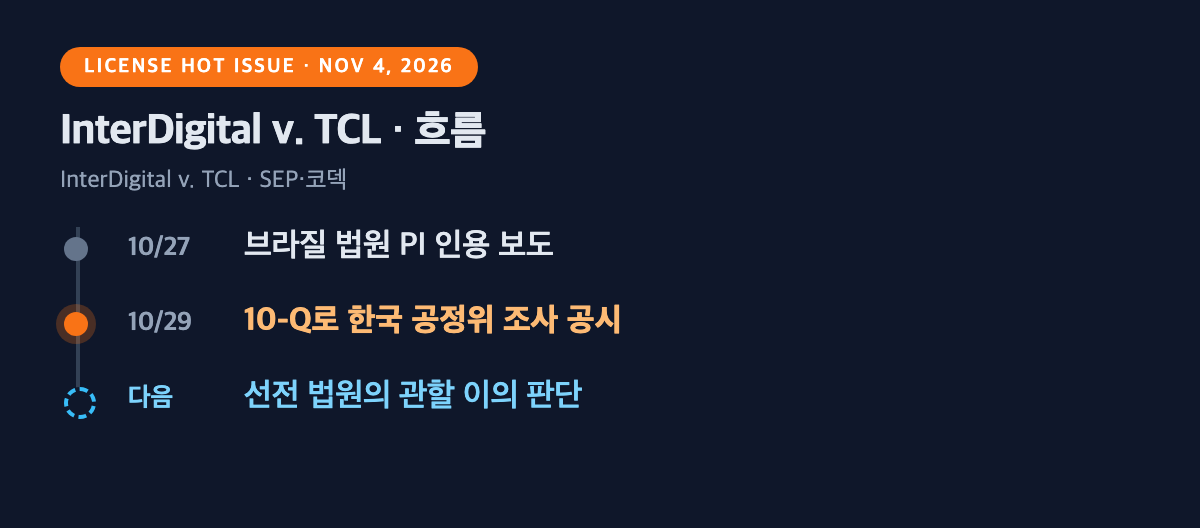
InterDigital v. TCL · InterDigital (SEC EDGAR) · 2026-10-29
지난 호에서 브라질 가처분 소식을 전해 드렸죠. 브라질 밖에서는 어떤 절차가 진행 중일까요? InterDigital은 10월 29일 제출한 분기보고서(10-Q)에서 Korean Fair Trade Commission이 TCL의 요청에 따라 자사 라이선싱 관행 조사를 시작한다고 통보해 왔다고 공시했습니다. 같은 보고서는 Regional Business Court of Rio de Janeiro가 2026년 10월 HEVC 관련 특허 침해 소송에서 TCL에 예비적 금지명령을 내렸다는 사실도 담았습니다.
TCL은 Shenzhen Intermediate People's Court에 소 두 건을 제기했습니다. 첫째는 InterDigital의 HEVC 라이선스 조건이 FRAND에 맞지 않는다는 확인과 TCL TV 제품에 적용할 글로벌 FRAND 조건 결정을 구하는 소송입니다. 둘째는 InterDigital이 중국 SEP의 라이선싱에서 시장지배적 지위를 남용했다는 확인과 손해배상을 구하는 소송입니다. InterDigital은 두 사건 모두에 관할 이의를 제기했고, 관할 이의는 현재 계류 중입니다.
에디터의 해석. TCL의 대응은 실시자가 흔히 택하는 방어 구도와 맞닿아 있습니다. 권리자가 금지명령으로 협상 압박을 높이면, 실시자는 자국 법원의 글로벌 요율 결정과 경쟁당국 조사로 그 압박을 상쇄하려 할 수 있습니다. 다만 한국 공정위의 조사 착수 통보가 공개됐고, 선전에서는 관할 이의가 계류 중입니다. 그래서 브라질 금지명령이 만든 협상력 차이가 당장 줄어든다고 보기는 어렵습니다.
실무 체크. HEVC를 탑재한 TV·디스플레이를 파는 실시자의 사내 IP팀은 브라질 등 판매 국가별 금지명령 위험과 매출 비중을 확인하고, 권리자와 주고받은 협상 기록이 성실한 실시자로 보일 만큼 갖춰져 있는지 점검하면 됩니다.
원문 「Form 10-Q for the quarterly period ended September 30, 2026」 보기 →
풀 요율
쓰지 않는 코덱 값도 내야 하나?
영국 High Court가 VDP Pool 1차 재판 구조를 대체로 Snap안대로 정했습니다
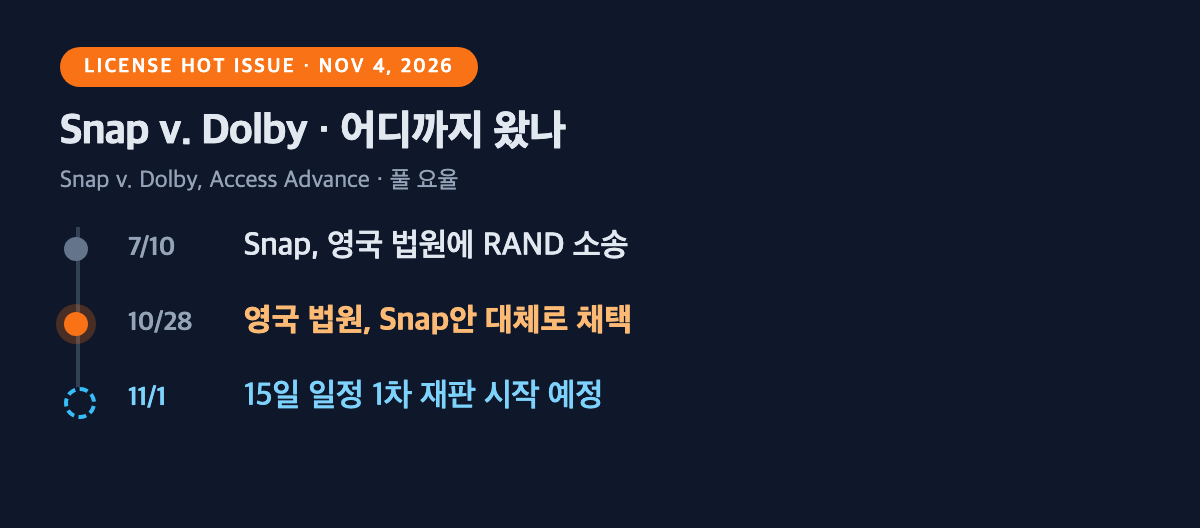
Snap v. Dolby, Access Advance · Patent Lawyer Magazine · 2026-10-29
풀 라이선스에서 쓰지 않는 코덱 값까지 치러야 하는지, 법원이 따져 줄까요? 2026년 10월 28일 영국 High Court의 Mr. Justice Mellor는 1차 재판을 대체로 Snap의 안대로 진행하라고 판결했습니다. 1차 재판에서는 Snap이 RAND 라이선스를 받을 자격이 있는지, 있다면 Video Distribution Patent(VDP) Pool 라이선스의 적정 조건이 무엇인지를 판단합니다.
15일 일정의 재판은 2027년 11월 1일 시작할 예정입니다. 이번 판결은 로열티 요율도, VDP Pool 현행 조건이 RAND에 맞는지도 정하지 않았습니다. Snap은 4개 코덱(HEVC·VP9·VVC·AV1)을 묶은 풀 가격 구조 때문에 쓰지 않는 코덱 값까지 내야 한다고 주장했습니다. Dolby는 자사 HEVC RAND 약속이 인코딩 청구항에는 미치지 않고, AV1에 대해서는 RAND 약속을 한 적이 없다는 입장입니다.
에디터의 해석. 이번 판결의 실무적 무게는 요율보다 심리 범위에 있습니다. 풀 라이선스는 일반적으로 여러 권리자의 특허를 묶어 거래 비용을 줄이는 구조이며, 여러 표준을 함께 다루기도 합니다. 그 묶음 단위가 RAND 심사 대상이 되면 풀 측은 가격 구성을 설명할 부담이 커질 수 있습니다. 또 Dolby가 인코딩 청구항과 AV1을 RAND 약속 밖에 두는 입장이라서, 재판은 요율을 따지기 전에 약속의 범위부터 다툴 가능성이 높습니다.
실무 체크. 여러 코덱을 묶은 풀 라이선스를 쓰는 실시자의 사내 IP팀은 제품별로 실제 쓰는 코덱이 무엇인지, 인코딩과 디코딩 중 어디에 쓰는지를 정리해 두면 됩니다.
원문 「Snap wins key ruling on scope of RAND patent pool trial against Dolby」 보기 →
정책·코덱
스트리밍 업계는 왜 USPTO를 찾았나?
MPA 등 10개 단체가 남용적 SEP 라이선싱에 대한 집행 지지를 요청했습니다
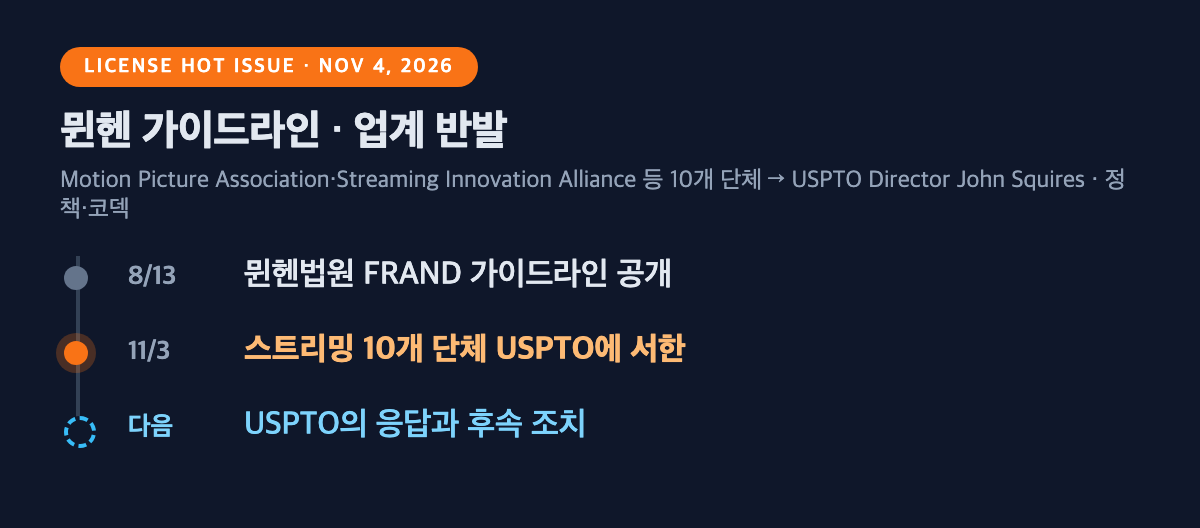
Motion Picture Association·Streaming Innovation Alliance 등 10개 단체 → USPTO Director John Squires · IPWatchdog · 2026-11-03
코덱 로열티 다툼에 왜 정책 당국까지 불려 나왔을까요? Motion Picture Association(MPA)과 Streaming Innovation Alliance를 포함한 스트리밍·방송·영상 미디어 10개 단체가 USPTO Director John Squires에게 서한을 보냈습니다. 서한은 남용적 SEP 라이선싱 관행에 대응하는 공공·민간 부문의 강력한 법 집행을 지지해 달라고 요청했습니다.
단체들은 일부 SEP 보유자가 표준이 널리 채택된 뒤 FRAND 약속을 어기고 금지명령을 무기로 과도한 로열티를 요구한다고 주장했습니다. 근거로는 2026년 8월 13일 뮌헨 제1지방법원 제7민사부가 공개한 자문적 FRAND 로열티 가이드라인을 들었습니다. 단체들은 법원이 주요 SVOD 서비스 2곳에 대해 연간 구독 매출의 3분의 1에 16%(프리미엄 서비스는 25%)를 적용하는 연간 코덱 로열티를 제안했다고 설명했습니다. 업계 전체에 낮은 요율만 적용해도 50억 달러가 훨씬 넘는 돈이 빠져나간다는 주장입니다. 가이드라인은 해당 재판부의 견해로, 다른 법원의 판단은 다를 수 있습니다.
에디터의 해석. 이 서한의 무게는 숫자에서 나옵니다. 로열티를 구독 매출에 비율로 연동하면 요금 인상이나 프리미엄 요금제 확대가 로열티 증가로 이어질 수 있습니다. 그래서 콘텐츠 사업자에게는 대당 단가 방식보다 예측하기 어려운 비용이 될 수 있습니다. 다만 서한은 업계의 주장인 만큼, USPTO의 대응은 지켜볼 대목입니다. 당장의 효과보다는 독일 법원 가이드라인에 맞서는 미국 업계의 논리가 공식 기록으로 남았다는 데 의미가 있습니다.
실무 체크. 스트리밍·OTT 사업자의 사내 IP팀은 보유한 코덱 라이선스가 매출 연동형인지 단가형인지 확인하고, 요금제를 바꿀 때 보고 의무와 감사 범위가 어떻게 달라지는지 점검하면 됩니다.
이번 주 소식의 공통점
세 건 모두 영상 코덱 로열티를 둘러싼 다툼이지만, 당사자마다 고른 무대가 다릅니다. TCL은 경쟁당국과 중국 법원의 요율 결정을, Snap은 풀 가격 구조 자체에 대한 RAND 심리를, 스트리밍 업계는 정책 당국을 향한 공개 서한을 택했습니다. 통상 코덱 요율은 양자 협상이나 풀 가격표로 정해져 왔습니다. 이런 다툼이 이어지면 권리자가 그 산정 근거를 법원과 당국 앞에서 설명할 부담이 커질 수 있습니다.
협상장 밖으로 이어진 코덱 요율 다툼
더 궁금해지는 이야기
브라질 금지명령이 이미 나왔는데, 한국 공정위 조사가 협상에 실제로 영향을 줄까요?
일반적으로 경쟁당국 조사는 결론까지 시간이 걸리므로, 이미 집행할 수 있는 금지명령의 압박을 단기간에 상쇄하기는 어렵습니다. 다만 조사가 시작되면 권리자의 라이선싱 관행이 공식 검토 대상에 오르기 때문에, 실시자는 협상에서 조건을 더 보수적으로 제시할 근거를 얻을 수 있습니다.
Snap 재판 결과가 나오기 전에 풀 라이선스 갱신을 앞둔 실시자는 무엇을 기준으로 판단해야 할까요?
재판은 2027년 11월 1일에 시작할 예정이고 이번 판결은 요율도, 현행 조건이 RAND에 맞는지도 정하지 않았으므로, 지금 풀 조건이 RAND에 어긋난다고 전제하기는 이릅니다. 갱신 협상에서 실제 쓰는 코덱과 사용 범위를 근거로 묶음 가격의 배분을 물은 기록을 남겨 두면, 협상에 성실히 참여했다는 점을 뒷받침하는 자료가 될 수 있습니다.
English Edition
Who will end up setting the right level for video codec royalties? This week we look at codec royalty disputes spanning courts in Brazil and China, the Korean Fair Trade Commission, the UK High Court and the USPTO. Rights holders use injunctions as negotiating leverage, while implementers turn to competition authorities and rate-setting suits. The streaming industry is appealing directly to policymakers. We look at where the fight over codec rates is playing out, and how each venue is shaping it.
In this issue
SEP·Codec TCL's response reaches the KFTC?
Pool rates Must you pay for codecs you don't use?
Policy/AV Why did streamers turn to the USPTO?
SEP·Codec · TCL's response reaches the KFTC?
InterDigital disclosed that the KFTC notified it of a probe launched at TCL's request
Last issue we covered the Brazilian preliminary injunction. What proceedings are underway outside Brazil? In its quarterly report (10-Q) filed on October 29, InterDigital disclosed that the Korean Fair Trade Commission notified it that it is opening an investigation into InterDigital's licensing practices at TCL's request. The same report also states that in October 2026 the Regional Business Court of Rio de Janeiro granted a preliminary injunction against TCL in an HEVC-related patent infringement case.
TCL has filed two suits in the Shenzhen Intermediate People's Court. The first seeks a declaration that InterDigital's HEVC licensing terms are not FRAND, along with global FRAND terms applicable to TCL's television products. The second seeks a declaration that InterDigital abused a dominant position in licensing its Chinese SEPs, along with damages. InterDigital's jurisdictional challenges in both matters remain pending.
Editor's take. TCL's response fits a defensive approach implementers commonly use. When a rights holder raises the pressure with injunctions, an implementer may try to offset it with a global rate determination in a home court and a competition authority probe. But the KFTC's notice of an investigation has been disclosed, and the Shenzhen jurisdictional challenges remain pending. That makes it hard to see the leverage gap created by the Brazilian injunction narrowing any time soon.
Practice check. In-house IP teams at implementers selling HEVC-enabled TVs and displays can review injunction risk and sales exposure in each market, including Brazil, and whether their negotiation record with the rights holder is complete enough to show them as a willing licensee.
Source: Form 10-Q for the quarterly period ended September 30, 2026 (InterDigital (SEC EDGAR)) →
Pool rates · Must you pay for codecs you don't use?
The UK High Court set up the first VDP Pool trial largely as Snap proposed
Will a court decide whether a pool licensee must pay for codecs it does not use? On October 28, 2026, Mr. Justice Mellor of the UK High Court ruled that the first trial should proceed largely as Snap proposed. The first trial will decide whether Snap is entitled to a RAND licence and, if it is, what the appropriate terms of a Video Distribution Patent (VDP) Pool licence are.
The 15-day trial is scheduled to begin on November 1, 2027. The ruling did not set a royalty rate, nor did it decide whether the VDP Pool's current terms are RAND. Snap argued that the pool's pricing structure, which bundles four codecs (HEVC, VP9, VVC and AV1), forces it to pay for codecs it does not use. Dolby's position is that its HEVC RAND commitment does not extend to encoding claims, and that it never made a RAND commitment for AV1.
Editor's take. The practical weight of this ruling lies in the scope of the trial, not the rate. A pool licence generally bundles patents from multiple rights holders to cut transaction costs and may cover multiple standards. Once that bundle becomes the subject of RAND review, the pool side may face greater pressure to explain how the price is built. And because Dolby places encoding claims and AV1 outside its RAND commitments, the trial is likely to fight over the scope of those commitments before it ever reaches the rate.
Practice check. In-house IP teams at implementers licensing multi-codec pools can map, product by product, which codecs they actually use and whether they use them for encoding or decoding.
Policy/AV · Why did streamers turn to the USPTO?
Ten groups including the MPA asked for support for enforcement against abusive SEP licensing
Why has a codec royalty fight now drawn in policymakers? Ten streaming, broadcast and video media groups, including the Motion Picture Association (MPA) and the Streaming Innovation Alliance, sent a letter to USPTO Director John Squires. The letter asked him to support strong public and private sector enforcement against abusive SEP licensing practices.
The groups argued that some SEP holders break their FRAND commitments once a standard is widely adopted, then use injunctions as leverage to demand excessive royalties. They cited advisory FRAND royalty guidelines published on August 13, 2026, by the 7th Civil Chamber of the Munich Regional Court I. The groups said the court proposed an annual codec royalty for two leading SVOD services calculated by applying 16% (25% for premium services) to one-third of annual subscription revenue. They argued that applying even the lower rate across the industry would drain well over $5 billion. The guidelines reflect that chamber's views, and other courts may reach different conclusions.
Editor's take. The letter's weight comes from its numbers. When royalties are tied to subscription revenue as a percentage, price increases or growth in premium tiers may lead to higher royalties. That can make them a less predictable cost for content companies than a per-unit rate. The letter, however, states the industry's position, so the USPTO's response is something to watch. Its significance lies less in any immediate effect than in putting the US industry's case against the German court's guidelines on the official record.
Practice check. In-house IP teams at streaming and OTT companies can check whether their codec licences are revenue-based or per-unit, and how reporting obligations and audit scope change when they alter their pricing tiers.
What connects them
All three stories are fights over video codec royalties, but each party has picked a different venue. TCL turned to a competition authority and to rate-setting in Chinese courts, Snap to RAND review of the pool's pricing structure itself, and the streaming industry to an open letter aimed at policymakers. Codec rates have usually been set through bilateral negotiation or pool price lists. As these disputes continue, rights holders may face greater pressure to justify how those rates are calculated before courts and regulators.
Codec rate disputes extend beyond the negotiating room
Questions you might have
With a Brazilian injunction already in place, will the KFTC probe actually affect negotiations?
Competition investigations generally take time to reach a conclusion, so they are unlikely to offset the pressure of an enforceable injunction in the short term. Still, once a probe opens, the rights holder's licensing practices come under formal review, which can give the implementer grounds to put forward more conservative terms in negotiations.
Before the Snap trial reaches a result, what should implementers facing a pool licence renewal base their decisions on?
The trial is scheduled to start on November 1, 2027, and this ruling neither set a rate nor decided whether the current terms are RAND, so it is too early to assume the pool terms fall short of RAND. If implementers ask during renewal talks how the bundled price is allocated, based on the codecs they actually use and how they use them, that record may help demonstrate good-faith participation in negotiations.
License Hot Issue는 공개된 국내외 보도와 법원·기관 발표에서 라이선스 계약·분쟁·로열티 관련 소식을 현직 IP 실무자가 AI로 수집·검증하고 직접 골라 정리합니다. 당사자의 주장은 주장으로 전하며, 개별 사안에 대한 법률 자문이 아니며 판단 전에는 반드시 원문을 확인하세요.
License Hot Issue curates public reports and court or agency releases on licensing deals, disputes and royalties, collected and fact-checked with AI and selected by a working IP practitioner. Party positions are reported as claims. This is not legal advice; always check the original source.
다뤄 줬으면 하는 분쟁이나 딜이 있다면 이 메일에 답장으로 알려 주세요. 다음 호를 고를 때 참고할게요.





의견을 남겨주세요