
License Hot Issue 제1호 · 2026년 10월 27일 화요일
안녕하세요. IP 실무 레이더 수요일판, License Hot Issue 첫 호입니다. 라이선스 오퍼가 적정한지는 결국 누가 판단하게 될까요? 이번 호에서는 브라질 법원이 독립 전문가 보고서를 근거로 InterDigital의 오퍼가 FRAND 의무를 충족했다고 보고 TCL에 가처분을 내렸고, 영국 특허청은 오퍼가 FRAND 범위 안에 있는지 의견을 주는 서비스를 검토하기 시작했어요. 이번 호는 협상 테이블 밖에서 오퍼의 적정선을 가늠하는 장치들이 어떻게 늘고 있는지, 그리고 합의 추진 뒤 소를 취하한 사례까지 살펴볼게요.
발행 안내. License Hot Issue는 다음 호부터 매주 수요일 아침에 발행합니다. 다음 호는 11월 4일 수요일에 찾아갈게요.
이번 호에서 살펴볼 것
SEP·코덱 브라질 법원은 왜 TCL에 HEVC 가처분을 냈나
FRAND 정책 특허청이 FRAND 오퍼에 의견을 낸다면?
분쟁 합의 Deutsche Bank, IV 상대 확인소송 접었다
SEP·코덱
브라질 법원은 왜 TCL에 HEVC 가처분을 냈나
독립 전문가 보고서 근거로 InterDigital 오퍼가 FRAND 충족
InterDigital v. TCL · ip fray · 2026-10-27
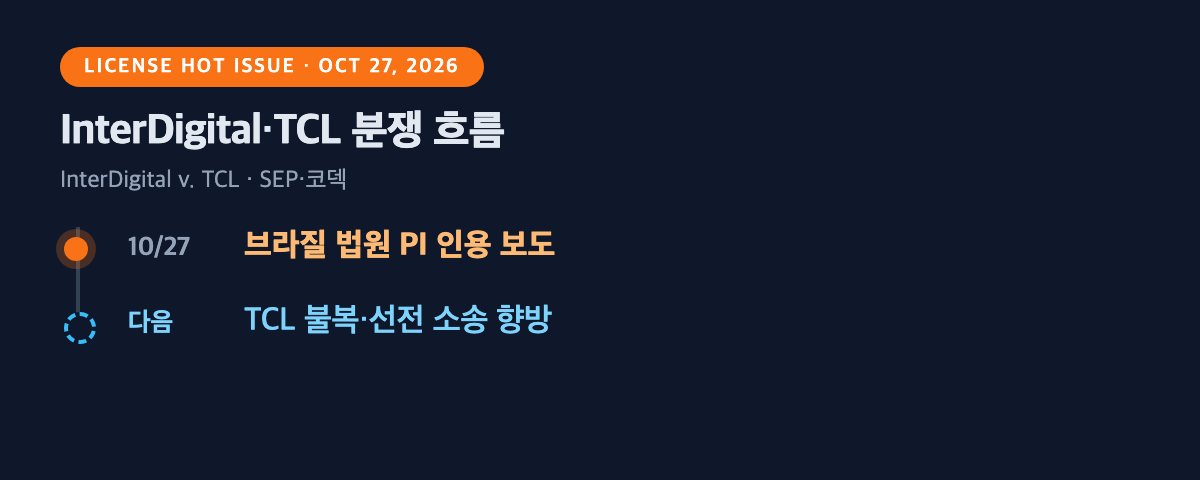
InterDigital과 TCL의 오퍼 가운데 어느 쪽이 FRAND에 가까웠을까요? 리우데자네이루 주 제3상사법원은 HEVC 관련 특허 2건을 근거로 InterDigital의 TCL 상대 가처분(PI)을 인용했습니다. 법원은 직접 의뢰한 독립 전문가 보고서의 결론, 즉 TCL이 두 특허를 침해했고 두 특허가 HEVC 표준필수특허이며 InterDigital의 오퍼가 FRAND 의무를 충족했다는 판단을 받아들였습니다.
법원은 TCL의 오퍼가 '차원이 다른 수준(a different order of magnitude)'으로 낮았다고 언급했습니다. 이에 따라 TCL은 브라질에서 제조·수입·판매 제안하는 기기에 HEVC 표준을 구현하는 것을 중단해야 합니다.
에디터의 해석. 이번 결정의 무게는 법원이 오퍼의 FRAND 여부를 직접 의뢰한 독립 전문가의 평가에 기대어 판단했다는 데 있습니다. SEP 협상에서는 오퍼 간 격차뿐 아니라 산정 근거와 협상 경위도 함께 살펴야 합니다. 큰 격차를 충분히 설명하지 못하면 성실한 실시자(willing licensee)인지 다투는 쟁점이 될 수 있고, 금지명령 위험은 협상력에도 영향을 줄 수 있습니다. HEVC 디코딩을 지원하는 TV 같은 제품군에서는 한 시장의 판매 중단 압력만으로도 전체 협상 일정이 앞당겨질 수 있습니다.
실무 체크. HEVC 탑재 기기를 브라질에 공급하는 실시자는 사내 IP팀과 함께 현재 카운터오퍼가 권리자 오퍼와 얼마나 벌어져 있는지, 그 산정 근거가 문서로 남아 있는지 점검해 두세요.
원문 「BREAKING: InterDigital wins PI against TCL in Brazil」 보기 →
FRAND 정책
특허청이 FRAND 오퍼에 의견을 낸다면?
UK IPO, 비구속 FRAND 의견 서비스 도입 여부 12월 15일까지 의견 수렴
UK IPO · ip fray · 2026-10-20
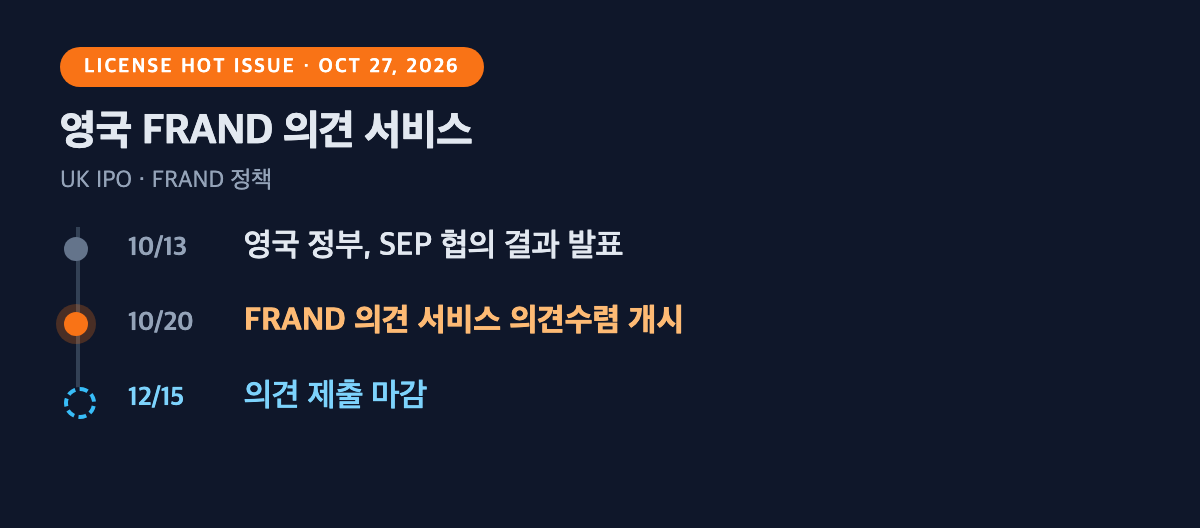
법원까지 가지 않고 오퍼가 FRAND 범위 안에 있는지 확인할 방법은 없을까요? 영국 특허청(UK IPO)이 2026년 10월 20일 자발적·비구속적 'FRAND Opinion Service' 도입 가능성에 대한 의견 수렴(call for evidence)을 시작했습니다. 도입된다면 이 서비스는 경제·가치평가·라이선스 증거를 바탕으로 SEP 라이선스 오퍼가 '타당한 FRAND 범위(plausible FRAND range)' 안에 있는지 서면 의견을 내게 됩니다.
다만 필수성·유효성·침해 판단, 라이선스 조건 강제, 손해배상 명령은 하지 않으며 소송·중재·조정을 대체하지도 않습니다. 영국 정부는 이에 앞서 10월 13일 SEP 협의 결과를 발표했고, 이번 의견 제출 기한은 2026년 12월 15일입니다.
에디터의 해석. 구속력이 없는 의견이라도 제3자가 '타당한 범위'를 서면으로 확인해 주면, 그 문서는 협상과 이후 분쟁에서 어느 쪽이 합리적으로 행동했는지 보여주는 자료로 쓰일 여지가 있습니다. 일반적으로 FRAND 협상의 쟁점은 요율 산정과 비교 라이선스 해석에 몰리는 경우가 많아, 가치평가만 떼어 보는 창구는 협상 자원이 적은 실시자에게 비용 부담을 낮추는 선택지가 될 수 있습니다. 반면 강제력이 없는 만큼 불리한 의견을 받은 쪽이 이를 무시할 수 있다는 한계도 분명합니다.
실무 체크. 영국 시장에서 SEP 라이선스를 주고받는 권리자·실시자는 12월 15일 마감 전에 이 서비스를 실제로 쓸지, 쓴다면 어떤 비교 라이선스 자료를 낼 수 있을지 사내 IP팀과 검토해 보세요.
원문 「UK IPO seeks views on feasibility of FRAND Opinion Service」 보기 →
분쟁 합의
Deutsche Bank, IV 상대 확인소송 접었다
10월 중 합의 진행 사실 공개 뒤 델라웨어 확인소송 자발적 취하
Deutsche Bank v. Intellectual Ventures · IPWatchdog · 2026-10-23
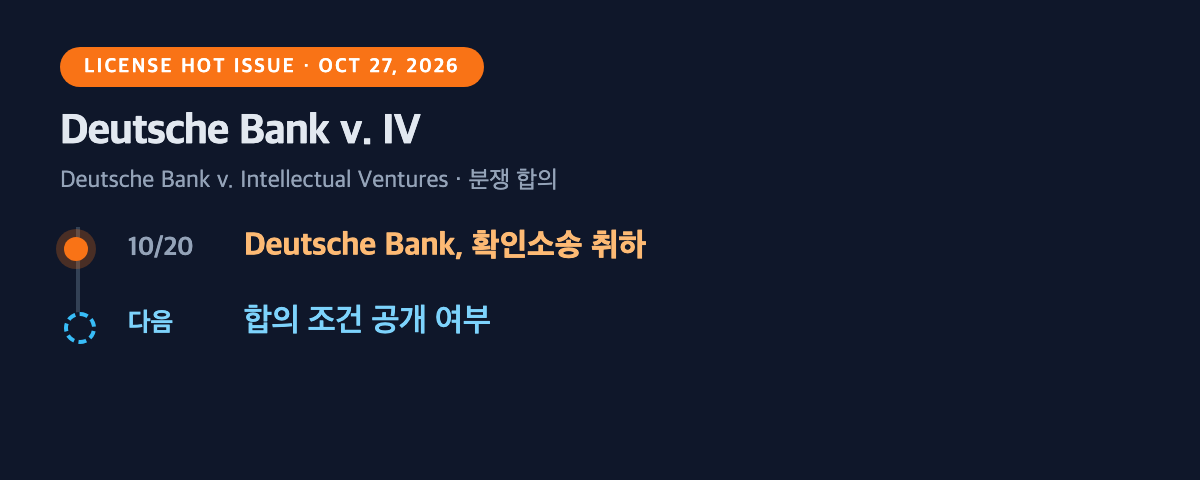
먼저 소송을 건 쪽은 왜 스스로 소를 거뒀을까요? Deutsche Bank 미국 자회사가 2026년 10월 20일 델라웨어 연방지방법원에 자발적 소 취하 통지를 내 Intellectual Ventures를 상대로 한 확인소송을 끝냈습니다.
이 취하는 10월 중 소 취하에 앞서 양측이 특허 침해 주장에 관한 합의를 진행 중이라고 밝힌 법원 제출 서류에 뒤이은 것입니다. 합의 조건과 금액은 기사에 나오지 않습니다.
에디터의 해석. 확인소송은 일반적으로 권리 행사 압박을 받은 쪽이 법정과 시점을 먼저 잡기 위해 제기하므로, 합의 국면에서 이를 거둬들였다는 것은 소송이 협상의 지렛대로 쓰였을 가능성을 보여줍니다. 이 기사에서는 요율 정보를 얻기 어렵지만, 합의 추진과 소 취하를 협상 전략의 관점에서 함께 살펴볼 수 있습니다. 제조업 밖의 금융 기업도 이런 라이선스 요구의 상대방이 된다는 점 역시 눈여겨볼 대목입니다.
실무 체크. 금융·서비스 기업의 사내 IP팀은 받은 특허 침해 주장과 대응 기록을 정리해 두고, 확인소송을 협상 수단으로 쓸 때의 비용과 효과를 미리 따져 보세요.
이번 주 소식의 공통점
세 기사는 라이선스 조건이 두 당사자의 맞교환만으로 정해지지 않는 흐름을 보여줍니다. 브라질 법원은 독립 전문가의 평가로 오퍼의 FRAND 여부를 가렸고, 영국 특허청은 그런 판단을 소송 전 단계에서 제공하는 창구를 검토하며, Deutsche Bank는 IV와 합의를 추진한 뒤 확인소송을 취하했습니다. 제3자가 오퍼의 적정선을 가늠하는 장치가 늘어날수록, 협상 단계에서 남긴 오퍼와 그 근거 자료가 분쟁 결과에 미치는 비중도 커집니다.
오퍼의 적정선, 이제 제3자가 먼저 묻는다
더 궁금해지는 이야기
브라질 가처분처럼 실시자 오퍼가 지나치게 낮다고 판단되면, 다른 나라에서 진행 중인 협상에도 영향을 주나요?
법적 판단은 법역마다 따로 이루어지므로 브라질 결정이 다른 나라 법원을 직접 구속하지는 않습니다. 다만 일반적으로 SEP 분쟁은 여러 법역에서 동시에 진행되고, 한 시장의 판매 중단 압력은 글로벌 라이선스 협상 전체의 일정과 요율 기대치에 반영되는 경우가 많습니다.
UK IPO의 FRAND 의견 서비스가 도입되면 권리자와 실시자 중 누구에게 더 유리한가요?
비구속 의견이라는 구조상 어느 한쪽에 일방적으로 유리하다고 단정하기는 어렵습니다. 일반적으로 협상 자원이 적은 실시자는 소송 없이 요율의 합리성을 확인할 수단을 얻고, 권리자는 자기 오퍼가 범위 안이라는 의견을 받으면 성실 협상 기록을 보강하는 자료로 쓸 수 있습니다.
English Edition
Hello, and welcome to the first issue of License Hot Issue, the Wednesday edition of IP Practice Radar. Who will ultimately decide whether a license offer is reasonable? In this issue, a Brazilian court, relying on an independent expert report, found that InterDigital's offer met its FRAND obligation and granted a preliminary injunction against TCL, while the UK IPO began exploring a service that would give opinions on whether an offer falls within a FRAND range. In this issue we look at how mechanisms for gauging offers outside the negotiating table are multiplying, and at a case where settlement efforts were followed by dismissal.
Schedule. From the next issue, License Hot Issue arrives every Wednesday morning. See you on Wednesday, Nov 4.
In this issue
SEP·Codec Why did Brazil enjoin TCL over HEVC?
FRAND What if the IPO assessed FRAND offers?
Settlement Deutsche Bank drops declaratory action vs. IV
SEP·Codec · Why did Brazil enjoin TCL over HEVC?
Independent expert report finds InterDigital's offer FRAND-compliant
Whose offer was closer to FRAND, InterDigital's or TCL's? The 3rd Business Court of the Judicial District of the Capital of Rio de Janeiro granted InterDigital a preliminary injunction (PI) against TCL based on two HEVC-related patents. The court adopted the conclusions of an independent expert report it had commissioned: that TCL infringed both patents, that the patents are HEVC standard-essential, and that InterDigital's offer met its FRAND obligation.
The court noted that TCL's offer was lower by 'a different order of magnitude.' As a result, TCL must stop implementing the HEVC standard in devices it manufactures, imports, or offers for sale in Brazil.
Editor's take. The weight of this decision lies in the court assessing FRAND compliance through an independent expert it appointed itself. In SEP negotiations, the basis for the offers and the negotiating history should be considered alongside the gap between offers. An inadequately explained gap may become an issue in assessing whether an implementer is a willing licensee, and injunction risk may affect bargaining power. For product categories that support HEVC decoding, such as TVs, sales-stop pressure in a single market can accelerate the timetable of the entire negotiation.
Practice check. Implementers supplying HEVC devices to Brazil should check with their in-house IP team how far their current counteroffer is from the holder's offer, and whether the basis for its calculation is documented.
Source: BREAKING: InterDigital wins PI against TCL in Brazil (ip fray) →
FRAND · What if the IPO assessed FRAND offers?
UK IPO consults until Dec 15 on a non-binding FRAND opinion service
Is there a way to check whether an offer is within the FRAND range without going to court? On October 20, 2026, the UK IPO opened a call for evidence on the feasibility of a voluntary, non-binding 'FRAND Opinion Service.' The service would issue written opinions, based on economic, valuation, and licensing evidence, on whether an SEP license offer falls within a 'plausible FRAND range.'
It would not, however, assess essentiality, validity, or infringement, impose license terms, or award damages, nor would it replace litigation, arbitration, or mediation. The UK government had earlier published the outcome of its SEP consultation on October 13, and the deadline for submissions is December 15, 2026.
Editor's take. Even a non-binding opinion, if a third party confirms a 'plausible range' in writing, could be used in negotiations and later disputes as evidence of which side behaved reasonably. In general, FRAND negotiations tend to turn on rate-setting and the interpretation of comparable licenses, so a forum that isolates valuation could lower costs for implementers with limited negotiating resources. On the other hand, with no binding force, the party receiving an unfavorable opinion can simply ignore it.
Practice check. SEP holders and implementers active in the UK market should review with their in-house IP team, before the December 15 deadline, whether they would use this service and what comparable-license evidence they could submit.
Source: UK IPO seeks views on feasibility of FRAND Opinion Service (ip fray) →
Settlement · Deutsche Bank drops declaratory action vs. IV
Voluntary dismissal in Delaware after earlier October settlement filing
Why would the party that filed first withdraw its own case? On October 20, 2026, Deutsche Bank's US subsidiary filed a notice of voluntary dismissal in the US District Court for the District of Delaware, ending its declaratory judgment action against Intellectual Ventures.
The dismissal followed a court filing earlier in October in which the parties stated they were working on a settlement of the patent infringement claims. The settlement terms and amount are not reported in the article.
Editor's take. A declaratory judgment action is generally filed by the party under assertion pressure to seize the choice of forum and timing, so withdrawing it at the settlement stage suggests the suit may have served as negotiating leverage. The article offers little information about rates, but the settlement efforts and dismissal can be considered together from the perspective of negotiation strategy. It is also worth noting that financial institutions outside manufacturing can be the counterparties to such licensing demands.
Practice check. In-house IP teams at financial and service companies should organize the infringement assertions they have received and their response records, and weigh in advance the costs and benefits of using a declaratory action as a negotiating tool.
What connects them
The three stories show that license terms are no longer set solely through exchanges between two parties. A Brazilian court used an independent expert's assessment to decide whether an offer was FRAND, the UK IPO is exploring a forum to provide such assessments before litigation, and Deutsche Bank dismissed its declaratory action after pursuing settlement with IV. As mechanisms for third parties to gauge an offer's reasonableness multiply, the offers and supporting records made during negotiation carry more weight in how disputes end.
Third parties now ask first whether an offer is fair
Questions you might have
If an implementer's offer is found far too low, as in the Brazilian PI, does that affect negotiations in other countries?
Legal determinations are made jurisdiction by jurisdiction, so the Brazilian decision does not directly bind courts elsewhere. Generally, however, SEP disputes run in parallel across multiple jurisdictions, and sales-stop pressure in one market is often reflected in the timetable and rate expectations of the global licensing negotiation.
If the UK IPO's FRAND opinion service is introduced, does it favor SEP holders or implementers?
Given its non-binding structure, it is hard to say it favors either side outright. Generally, implementers with limited negotiating resources gain a way to test rate reasonableness without litigation, while holders who receive an opinion that their offer is within range can use it to strengthen their record of good-faith negotiation.
License Hot Issue는 공개된 국내외 보도와 법원·기관 발표에서 라이선스 계약·분쟁·로열티 관련 소식을 현직 IP 실무자가 AI로 수집·검증하고 직접 골라 정리합니다. 당사자의 주장은 주장으로 전하며, 개별 사안에 대한 법률 자문이 아니며 판단 전에는 반드시 원문을 확인하세요.
License Hot Issue curates public reports and court or agency releases on licensing deals, disputes and royalties, collected and fact-checked with AI and selected by a working IP practitioner. Party positions are reported as claims. This is not legal advice; always check the original source.
다뤄 줬으면 하는 분쟁이나 딜이 있다면 이 메일에 답장으로 알려 주세요. 다음 호를 고를 때 참고할게요.






의견을 남겨주세요