
Hey everyone,
Summer's right around the corner,
and we're back with a fresh edition of the Playio Newsletter 🎮
If you've been in the mobile UA trenches lately, you already know —
finding new users the old way is getting harder by the quarter.
Acquisition costs keep climbing.
Your target audiences increasingly overlap with competitors'.
And if you're only fishing in the same genre pool, the returns are shrinking fast.
So naturally, the question a lot of teams are asking right now is:
"Where do we find net-new users who'll actually engage with our game?" 👀
Here's what caught our attention:
Playio's latest behavioral data shows that players are crossing genre lines far more than most UA strategies account for.
In this edition, we're breaking down:
- 🎯 Cross-genre user movement patterns from Playio's Q1 2026 data
- 🍬 A puzzle genre case study on driving long-term ROAS through D30
Let's get into it.
Newsletter at a Glance📌
- [Playio Data Unboxing #3] Can players from other genres become your next high-value users?
- Puzzle Genre ROAS — Is it really possible to sustain growth through D30?
🎯 [Playio Data Unboxing #3]Can players from other genres become your next high-value users?

We're already past Q1 2026.
How are your UA targets and ROAS trajectories holding up against the goals you set in January?
We've been hearing a consistent theme from partners:
- Legacy UA channel efficiency is declining
- CPIs keep rising
- Everyone's bidding on the same user profiles
That's pushing more teams to explore beyond their core genre audiences — and the data suggests they should be.
Because here's the thing:
Playio's Q1 2026 behavioral data reveals that Korean mobile gamers move across genres far more fluidly than conventional targeting assumes. 👀
📊 Two Out of Three Users Actively Engage Across Multiple Genres
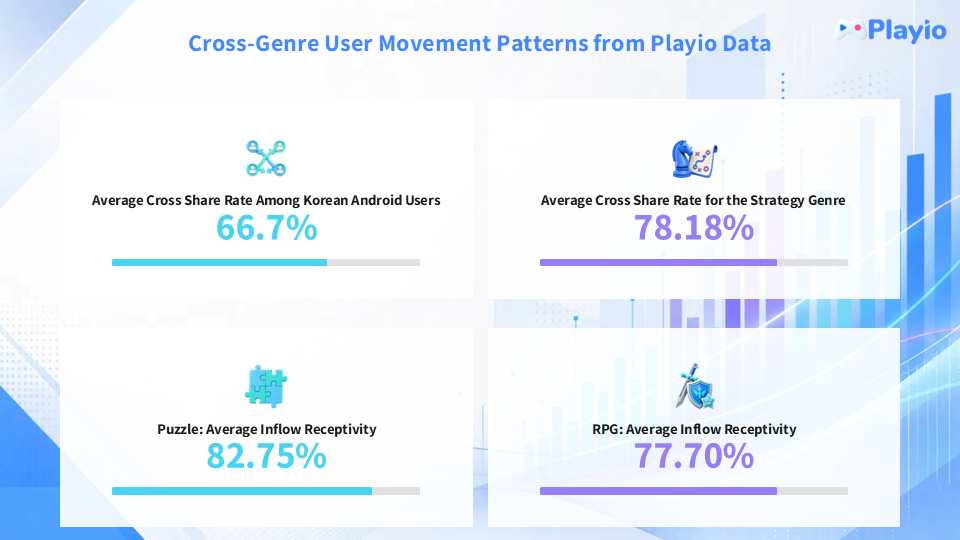
In Q1 2026, the average Cross Share among Korean Android users on Playio was 66.7%.
In plain terms: the majority of players aren't sticking to a single genre. They're playing across the board.
⚔️ Strategy Players Are the Most Genre-Fluid
The standout segment? Strategy genre users, with an average Cross Share of 78.18% — well above the platform average.
These players were actively engaging with RPG, puzzle, and arcade missions alongside their strategy gameplay.
It makes sense: users comfortable with complex progression systems and layered mechanics tend to adapt quickly to unfamiliar genres and actively seek out new experiences.
🧩 Puzzle & RPG Are the Genres Everyone Gravitates Toward
On the flip side, when we looked at where cross-genre users were flowing into, two genres stood out:
📌 Puzzle — average inflow receptivity: 82.75%
📌 RPG — average inflow receptivity: 77.70%
Regardless of a user's primary genre, the probability of them also engaging with puzzle or RPG content was consistently high.
Puzzle benefits from its low-friction, pick-up-and-play structure — it naturally serves as a secondary genre.
RPG draws users in through progression and collection loops, creating strong long-session engagement.
👀 The Takeaway: Target Play Styles, Not Genre Labels
What this data makes clear is that Korean gamers — and likely players in other mature markets — are far more fluid than static genre segments suggest.
Instead of bucketing users as "RPG players" or "puzzle players," the more effective lens is behavioral:
✔ What gameplay loops are they comfortable with?
✔ What reward structures drive their engagement?
✔ How do they discover and explore new titles?
Behavior-based understanding is becoming more important than genre-based targeting.
🤖 How Playio Puts This Into Practice
Playio leverages cross-genre movement patterns and granular play data to identify users with a high likelihood of engaging with your specific title.
For example:
🎯 RPG players with deep strategy engagement histories
🎯 Action players who index high on puzzle playtime
🎯 High-involvement users who consistently explore across genres
These are user segments that traditional genre-based targeting simply can't surface.
Rather than assuming "RPG players only want RPG games," we're identifying which gameplay loops and reward structures actually drive response — and using that to unlock new pockets of demand.
❓ "Isn't High Cross Share Just a Reward Platform Effect?"
Fair question.
Yes, on a reward-based platform, users naturally have incentive to try multiple genres.
But as we covered in Playio Data Unboxing #1, the data tells a deeper story: users who complete Time Quests and collect their rewards continue to show strong re-engagement and sustained play well beyond the reward event. 👀
Rewards may be the initial hook — but genuine gameplay retention follows.
Ultimately, the key question for new user acquisition isn't "what genre do they prefer?" — it's "how do they engage with games?" 🎮
New user opportunities may be hiding in genres you haven't considered.
Have questions? Let's talk.
🍬 Puzzle Genre ROAS: Can You Really Sustain It Through D30?
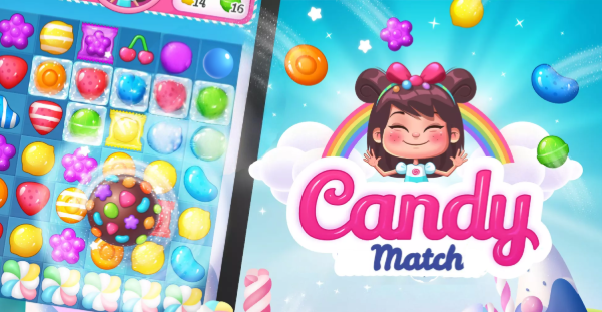
A <Candy Match> Case Study in Long-Term ROAS Operations
Puzzle games are known for low entry barriers and fast user acquisition — but also for rapid early-stage churn and the difficulty of driving long-term monetization.
This is especially true for IAA-first titles, where minimizing post-install drop-off is critical to ROAS stability.
This case study walks through how Playio designed the user engagement flow for <Candy Match – Dream Factory> and extended ROAS performance through D30.
🎮 About the Partner & Title
Sparks Games
Sparks Games is a mobile game studio focused on casual and puzzle titles. Their design philosophy centers on smooth onboarding, low-friction repeat play, and content pacing that keeps users engaged across sessions. They publish a range of casual titles for global audiences.
<Candy Match - Dream Factory>
<Candy Match – Dream Factory> is a match-3 puzzle game where players connect 3+ same-colored candies to clear stages. Built around short, repeatable play sessions, it offers varied difficulty levels and stage designs to sustain engagement over time.
📌 Campaign Objectives
While puzzle titles generally see healthy top-of-funnel numbers, the real challenge is retaining users through deeper content and monetization stages.
This campaign focused on three priorities:
🎯 Securing meaningful early playtime and stabilizing retention
🎯 Driving repeat sessions to maximize ad impression volume
🎯 Guiding users into long-term ROAS windows
🚀 How We Built a Path to Long-Term ROAS
The campaign was structured around three engagement levers:
⏱️ Time Quests — turning play sessions into habit loops
💎 Hidden Quests — bridging users into later-stage monetization milestones
👥 Community Events — filling retention gaps at key churn points
The results: stable retention and sustained ROAS growth across all three markets.
Retention
| Region | D1 | D7 |
|---|---|---|
| KR | 62% | 52% |
| JP | 56% | 40% |
| TW | 56% | 43% |
ROAS
| Region | D1 | D7 | D14 | D30 |
|---|---|---|---|---|
| KR | 66% | 150% | 190% | 195% |
| JP | 74% | 150% | 184% | 188% |
| TW | 73% | 141% | 165% | 168% |
The key insight from this campaign wasn't just about extending playtime — it was about calibrating reward density and pacing the gameplay flow so that ROAS continued to climb even in later windows.
Players are moving more freely than ever, and the UA landscape is evolving just as fast.
We'll keep running experiments, digging into the data, and sharing what we find.
Until next time 🎮
Grow with Real Gamer!
Rewarding Time. Driving Growth. Powered by Playio.