
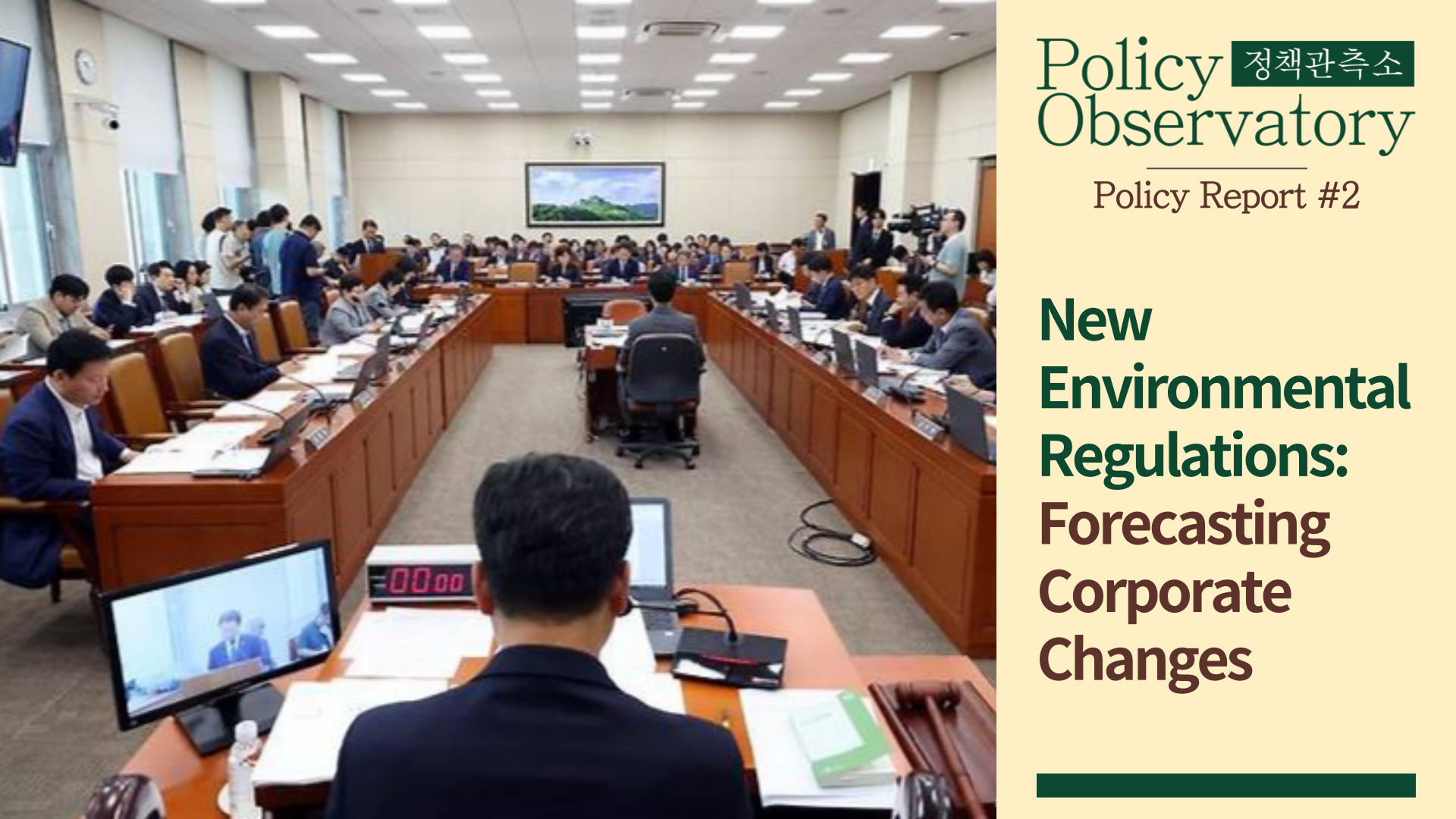
The Ministry of Environment is expanding surveillance of illegal and harmful products in online distribution of overseas direct purchase items, and is pushing for achievable formulation of the 2035 NDC (Greenhouse Gas Reduction Target) to achieve responsible carbon neutrality.
To promote a circular economy ecosystem, regulations are being relaxed to facilitate the recycling of high-value waste materials such as used batteries and waste oil into recycled products. Analyze the Ministry of Environment's plans meticulously through the report and prepare response strategies to seize opportunities.
Table of Contents
1. Introduction
2. Key Investments in the 2024 Ministry of Environment Budget
3. Major Highlights from the Ministry of Environment's Parliamentary Report
4. Changes Industry Should Pay Attention To
5. Conclusion
<Attachment> Ministry of Environment Parliamentary Report File
1. Introduction
Following the dramatic completion of the National Assembly's structure, chairs and vice chairs have been appointed for each standing committee. The Environment and Labor Committee, having completed the appointments of its chair and vice chair, convened a plenary session on June 28 to receive operational reports from the Ministry of Environment, Ministry of Employment and Labor, and the Korea Meteorological Administration. The committee will proceed promptly with the review of bills and policies following the report.
2. Key Investments in the 2024 Ministry of Environment Budget (Total Expenditure: KRW 14,349.3 billion, ▲6.5%)
1) Expansion of Dimensional Infrastructure
- National River Restoration: KRW 662.7 billion, ▲46.9%
- Construction of New Dams: 10 new sites, KRW 6.3 billion
- Construction of Existing Small-scale Dams: KRW 15.5 billion, ▲36%
- Sewerage and Canal Urban Flood Response: KRW 3,275 billion, ▲112.5%
- Flood Control Facilities at Gangnam Station, Gwanghwamun, and Dorimcheon: KRW 26.2 billion, ▲208.2%
- AI Flood Forecast System Establishment: KRW 81.8 billion, ▲384%
- Dam-River Digital Twin Platform: KRW 17.9 billion, ▲314.8%
2) Promotion of Green Industries
- Carbon Neutrality, Green ODA: KRW 30.1 billion, ▲143.6%
- Green Infrastructure Export Support Fund: KRW 30 billion, new
- Pollution-free Vehicle Charging Infrastructure: KRW 734.4 billion, ▲41.5%
- International Greenhouse Gas Reduction: KRW 23.6 billion, ▲126.9%
3) Environmental Services
- Asbestos Damage Relief Benefits: KRW 45.5 billion, ▲64.3%
- Eco-friendly Boiler Support for Low-income Families: KRW 9 billion, ▲150%
- Expansion of Underground Water Retention Dam Installation in Chronic Water Scarce Areas: From KRW 0.3 billion to KRW 10.8 billion
- Algae Reduction Facilities: KRW 5 billion, ▲87.4%
- Establishment of Recycling and Upcycling Systems: KRW 4.4 billion, ▲83.3%
3. Major Highlights from the Ministry of Environment's Parliamentary Report
The Ministry of Environment has established "Sustainable Future through Carbon Neutrality" as a national policy goal, striving for carbon neutrality while tackling climate crises through robust water management, sustainable natural ecosystem creation, and healthy living environment construction.
1) Protection of Livelihoods through Safe Environmental Management
(1) Flood Measures
- Implementation of AI flood forecasting utilizing advanced technology
- Providing flood warning navigation guidance
- Expansion of flood defense infrastructure such as dam construction and river dredging
(2) Safe Management of Hazardous Chemical Substances
- Strengthening compliance inspections of safety management standards for facilities handling hazardous chemicals
- Expansion of safety monitoring for illegal and harmful products in online distribution of overseas direct purchase items
- Verification of disaster prevention and firefighting facilities
- Improvement of facilities and consulting support for vulnerable industries and SMEs
2) Economic Support through Carbon-free Green Growth
(1) Greenhouse Gas Reduction
- Implementation of sector-specific reduction tasks for transport and energy to achieve the national greenhouse gas reduction target by 2030
- Preparation for the formulation and international submission of the national greenhouse gas reduction target for 2035
(2) Promotion of Green Industries
- Consulting, financial support, and market development support for fostering innovative green companies
- Support for overseas expansion of outstanding green companies
- Tailored strategies considering local demands by country
- Diversification of export routes and achieving this year's export target
3) Realization of a Warm Society through Environmental Welfare
(1) Conservation of Natural Assets
- Designation and management of outstanding natural asset areas as protected areas
- Promotion of high-quality eco-tourism
(2) One-stop Environmental Damage Service
- Establishment of a one-stop service system enabling resolution of environmental damage with a single application
- Strengthening environmental management of children's activity spaces
4. Changes Industry Should Pay Attention To
1) Safe Environmental Management
- Enhanced subsidies for high-performance electric and hydrogen vehicles to achieve distribution of 900,000 pollution-free vehicles (cumulative).
- Expansion of systems managing fine dust reduction facilities automatically, providing incentives to target businesses (adjusting self-measurement cycles, etc.).
- Display of raw material safety information on consumer chemical products.
- Expansion of surveillance on illegal and harmful products in online distribution of overseas direct purchase items.
2) Carbon-free Green Growth
- Improving emissions trading scheme to benefit companies reducing carbon emissions, through increased allocation of permits and introduction of financial products linked to emissions trading.
- Establishment of achievable 2035 national greenhouse gas reduction targets.
- Enhancement of environmental information disclosure items in accordance with international standards, adjusting disclosure timings (from December to August), thereby enhancing ESG disclosure global consistency.
- Relaxation of regulations such as recognizing high-value waste materials like waste batteries and waste oil as recycled products.
5. Conclusion
The Ministry of Environment's 2024 major operational plan consists of three pillars: safe environmental management, carbon-free green growth, and comprehensive environmental welfare. Industries should proactively respond to these policy changes.
For more detailed information and professional analysis, please contact us. We will support you in making accurate judgments and preparing effective response strategies.
<Attachment> Ministry of Environment Parliamentary Report File

![[특별호] 시멘트 업계의 위기의 썸네일 이미지](https://cdn.maily.so/202407/1720754763451083.jpeg)
![[PASC General Meeting] Inquiry into the Fire Incident at the Primary Battery Manufacturing Plant의 썸네일 이미지](https://cdn.maily.so/202407/1719982691399187.jpeg)
![[Special Issue] Crisis in the Cement Industry의 썸네일 이미지](https://cdn.maily.so/202407/1720755990017626.jpeg)
![[행정안전위원회 전체회의] 1차전지 제조공장 화재사고 현안질의의 썸네일 이미지](https://cdn.maily.so/202407/1719913006987992.jpeg)



의견을 남겨주세요