
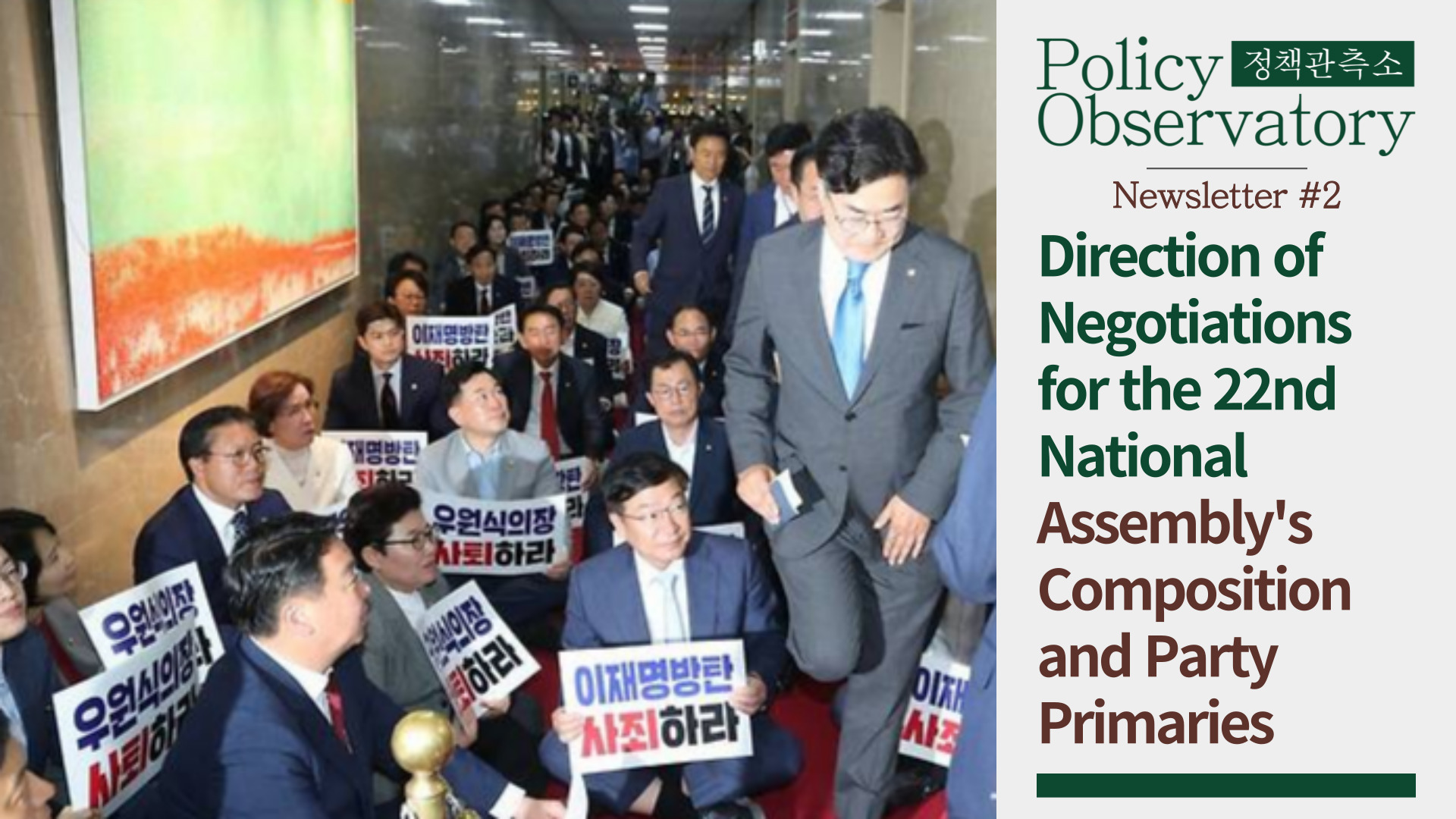
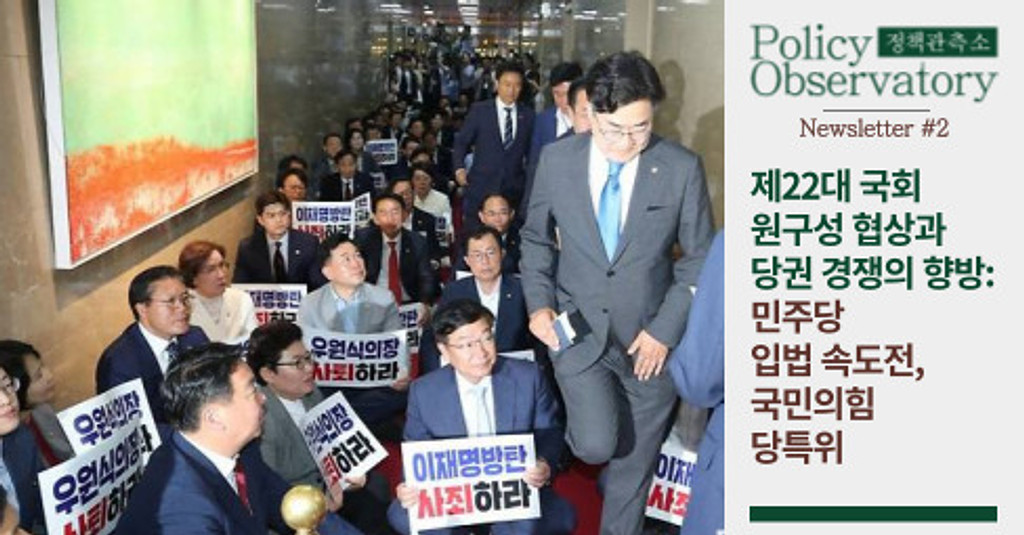
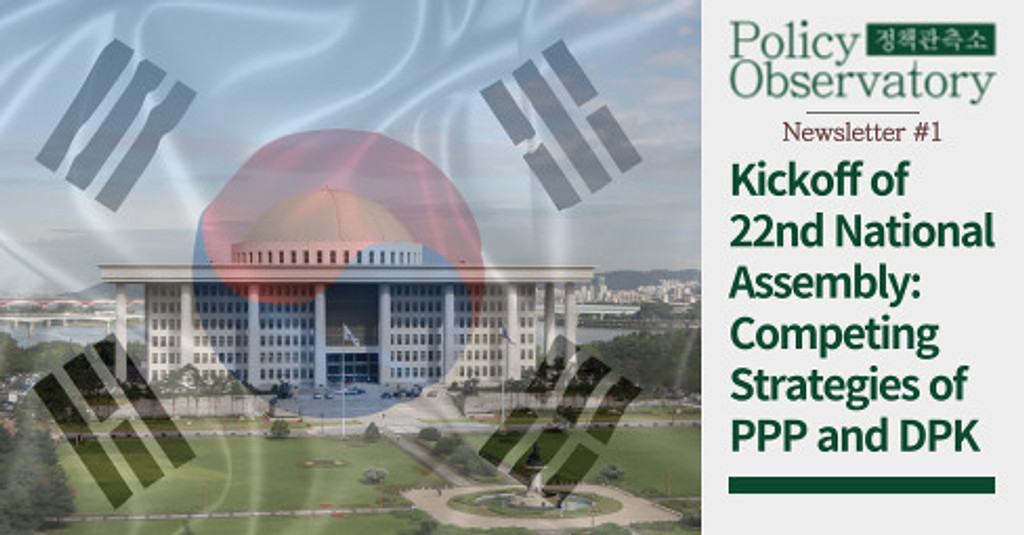
The direction of the 22nd National Assembly: Negotiations on the composition of committees and leadership competition within parties.
The industrial sector should carefully observe legislative moves by DPK and responses from the PPP to seize opportunities.
Contents
1. The composition of the 22nd National Assembly is adrift.
2. Confrontation between ruling and opposition parties
3. Preparation for party conventions
4. Conclusion
1. The composition of the 22nd National Assembly is adrift.
(1) Current situation and respective positions
1) Progress
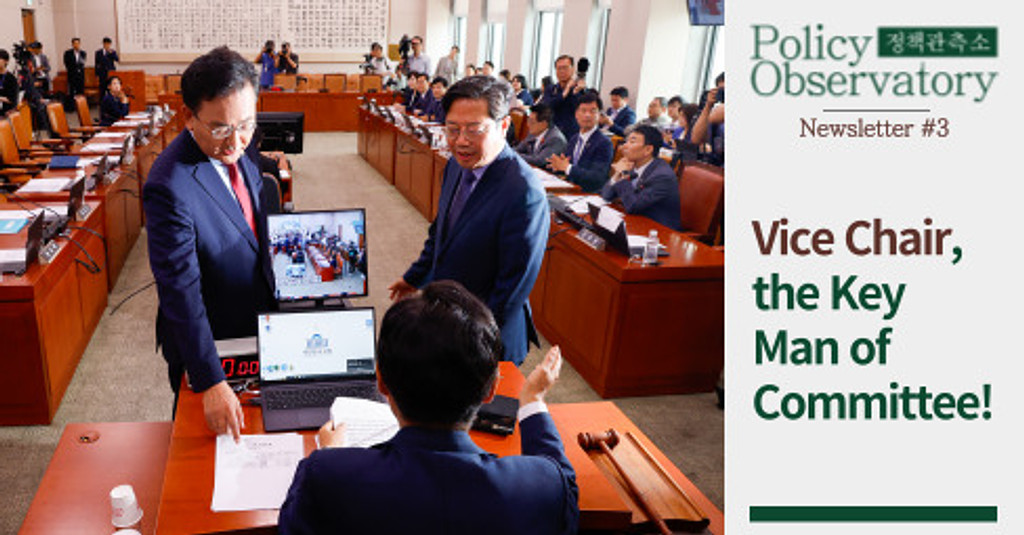
On June 10, DPK, amidst the absence of PPP, independently elected 11 out of 18 standing committee chairpersons, including members from across the political spectrum such as the Rebuilding Korea Party and the Reform Party.
Park Chan-dae was elected as the Chairman of House Steering Committee, Jung Cheong-rae as the Chairman of Legislation-Judiciary Committee, Kim Young-ho as the Chairman of Education Committee, Choi Min-hee as the Chairman of Science-ICT-Broadcasting-Communications Committee, Shin Jung-hoon as the Chairman of Public Administration and Security Committee, Jeon Jae-soo as the Chairman of Culture-Sports-Tourism Committee, Uh Ki-gu as the Chairman of Agriculture-Food-Rural Affairs-Oceans-Fisheries Committee, Park Joo-min as the Chairman of Health-Welfare Committee, Ahn Ho-young as the Chairman of Environment-Labor Committee, Maeng Sung-kyu as the Chairman of the Land-Infrastructure-Transport Committee, and Park Jeong as the Chairman of Special Committee on Budget and Accounts.
On June 17, under the chairmanship of Woo Won-shik, Speaker of the National Assembly, negotiations on the composition of the committees were initiated by Choo Kyung-ho, Floor Leader of PPP, and Park Chan-dae, Floor Leader of DPK, but no consensus was reached. On the 19th, DPK firmly rejected the alternative proposed by PPP, highlighting significant differences between the parties, making it difficult to conclude committee negotiations in the short term.
2) People Power Party (ruling party)
On June 18, PPP confirmed the invalidity of the allocation of committee chairs through its elected standing committee chairs (11 out of 18) and filed a constitutional adjudication request with the Constitutional Court. Additionally, they formed 15 special committees under the Party Policy Committee to address livelihood issues separately. Regarding the composition of committees, according to the briefing by Choo Kyung-ho, Floor Leader of PPP, on June 19, they requested DPK to rotate the chairmanships of the Legislation-Judiciary Committee and the Steering Committee annually but were refused.
3) Democratic Party of Korea (opposition)
Park Chan-dae, Floor Leader of DPK, stated that "to demonstrate proper oversight and the parliamentary aspect of the National Assembly's work, if necessary, the remaining 7 standing committee chairs must also be elected." Regarding PPP's June 18 proposal (rotating chairmanships annually), he strongly criticized it, stating, "If the president refrains from using veto power for a year, we may consider it," and emphasized, "There is no way to find sincerity."
4) Woo Won-shik, Speaker of the National Assembly
Speaker Woo stated that "for the opposition to take charge of all 18 standing committee chairs is an infringement on the rights of the people who supported PPP," and emphasized, "The distribution of standing committee chairs should be equitable, with 11 for one party and 7 for the other." On the 19th, he issued a final notice to the leaders of both negotiating parties to conclude the committee negotiations by the coming weekend, urging them to approach the negotiations with the intention of concluding the composition of the National Assembly in a manner that is fair and desirable to the public.
2. Confrontation between ruling and opposition parties
(1) DPK's legislative speed race
Following the independent resolution of the National Assembly's composition, DPK continues to hold solo standing committee meetings. They demand attendance of government officials, including ministers, at these committees and have introduced a bill to amend the law to penalize non-attendance at National Assembly hearings. Additionally, the Democratic Party held its first Policy Assembly of the 22nd National Assembly and adopted 22 bills and 1 resolution.
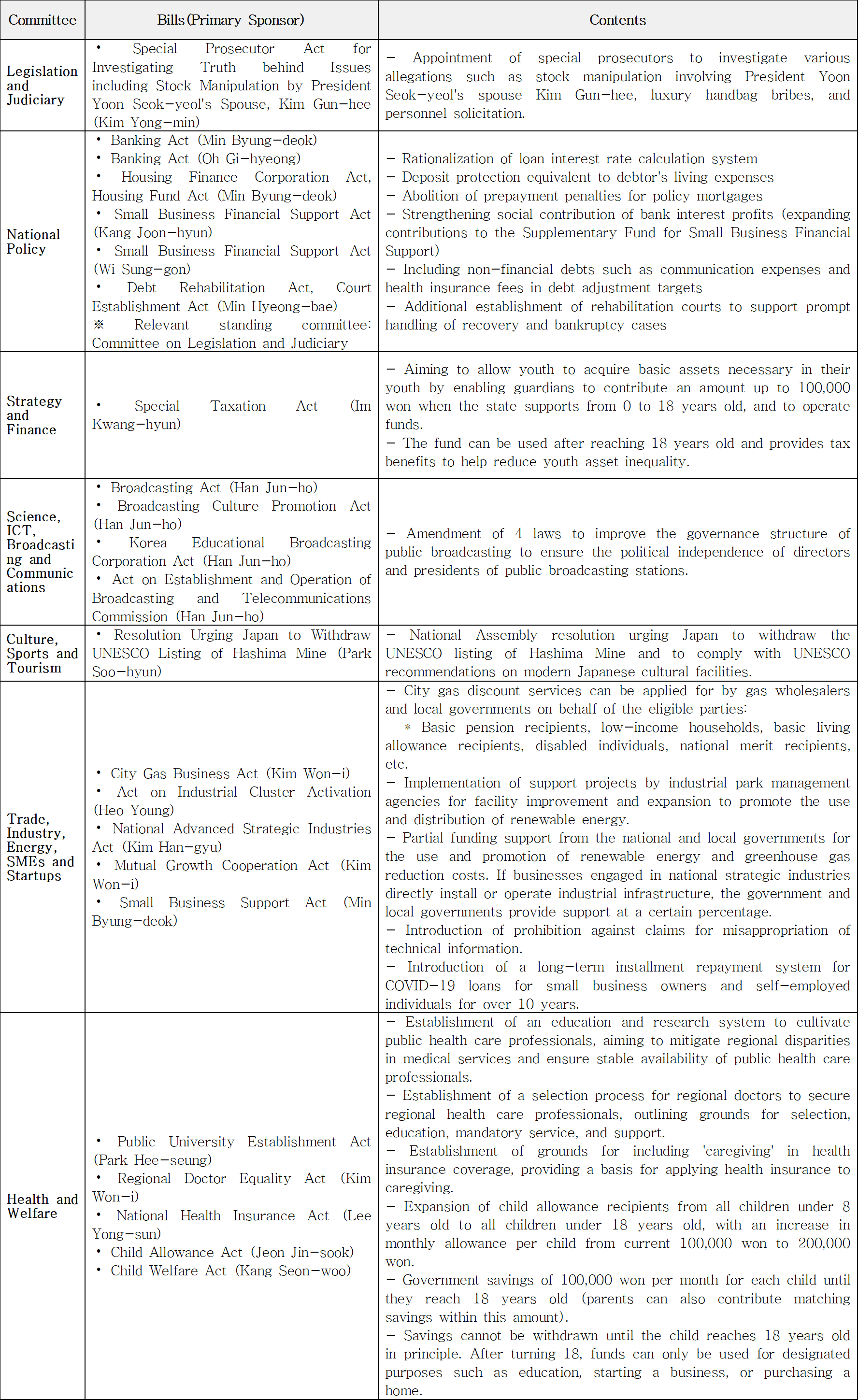
(2) PPP's response through party-specific committees
PPP strongly criticizes the opposition's independent opening of committees and plans to resolve livelihood issues through its own special committees. On June 7, PPP formed 15 internal policy special committees, where deputy ministers attend, excluding the opposition, to facilitate smooth communication with the administration.
The respective special committees and chairpersons are as follows:
- Low Birthrate Response Special Committee (Kim Jung-jae), Livelihood Economic Stability Special Committee (Kim Sang-hoon), Tax Reform Special Committee (Song Eon-seok), AI · Semiconductor Special Committee (Go Dong-jin), Energy Special Committee (Kim Sung-won), Healthcare Reform Special Committee (In Yo-han), Pension Reform Special Committee (Park Soo-young), Climate Response Special Committee (Im Yi-ja), Labor Special Committee (Im Yi-ja), Fair Media Special Committee (Park Dae-chul), Disaster Safety Special Committee (Lee Man-hee), Vulnerable Groups Support Special Committee (Kim Mi-ae), Diplomacy and Security Special Committee (Han Ki-ho), Education Reform Special Committee (Seo Beom-su), Culture and Sports Special Committee (Kim Hee-jung).
3. Preparation for party conventions
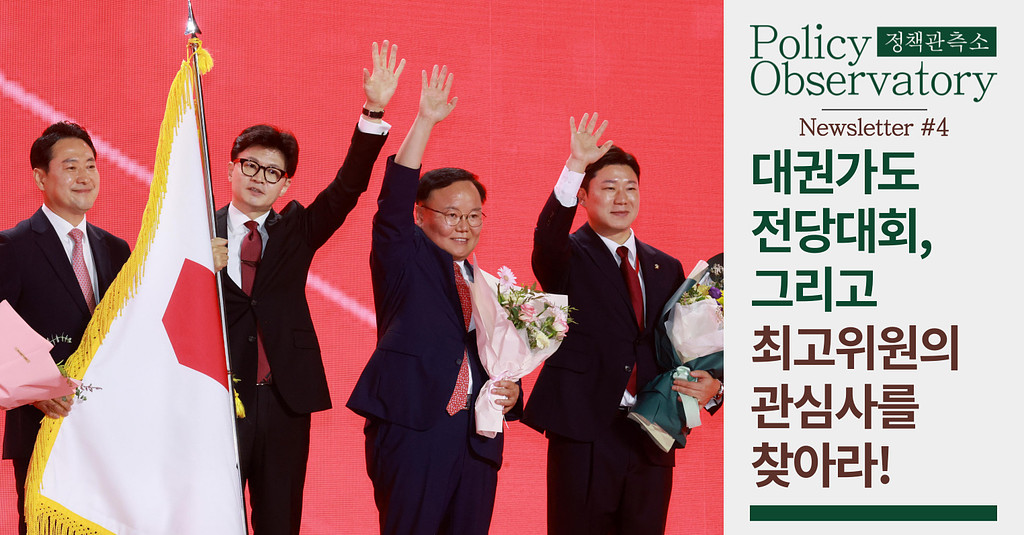
(1) PPP's convention in the spotlight
To elect a new party leader, PPP will accept candidate applications from June 24 to 25 for two days and hold a final runoff vote on June 28 if no candidate secures a majority on July 23. On June 19, the rules for the primary were determined. The party charter was amended to reflect 80% from party members and 20% from general public opinion surveys. Previously, the rule was to elect the leadership solely based on the votes of party members, but it appears that this change reflects the opinion that the proportion of public opinion should be increased after losing the general election.
Meanwhile, Han Dong-hoon, former interim chairman, is accelerating his preparations ahead of his candidacy declaration for party leader. He is confirmed to have started preparations, including drafting a candidacy declaration and securing an office in Yeouido (Daesan Building). In addition, former Minister Won Hee-ryong is reportedly seriously considering a bid for party leader, while Representative Kim Jae-seob, who was expected to run, announced on June 20 via social media that he will not run in the party convention.
Potential candidates for party leadership include Han Dong-hoon, Won Hee-ryong, Na Kyung-won, Yoon Sang-hyun, and Yoo Seung-min. According to a recent opinion poll, Han Dong-hoon, former chairman, was considered the most suitable candidate for the next party leader among People Power Party supporters, with 59%, followed by former Minister Won Hee-ryong at 11%, and Representative Na Kyung-won at 10%.
(2) DPK, re-election of Lee Jae-myung as leader : Preparing for presidential challenge
DPK appears to be smoothly preparing for the re-election of Lee Jae-myung, who led the victory in the 22nd general election, and his presidential challenge. On June 17, the Democratic Party Central Committee decided to amend the party charter to allow exceptions to the resignation deadline for party leaders intending to run for president. Previously, if a DPK leader or senior member wanted to run for president, they had to resign by March 2026, a year before the presidential election. However, with the amendment, in cases of "special and significant reasons," the resignation deadline can be set differently by decision of the Party Central Committee.
Lee Jae-myung is expected to resign from his position as party leader early and declare his intention to challenge for the presidency. At the same time, lawmakers such as Kim Min-seok, Kang Seon-woo, Min Hyeong-bae, and Han Jun-ho are widely expected to run for senior positions, and it is anticipated that a "2nd term pro-Lee leadership" will be established within the party.
There are concerns about this. Kim Young-jin, a pro-Lee lawmaker, has consistently expressed opposition to Lee Jae-myung's re-election, and former lawmaker Woo Sang-ho has also expressed doubts about whether Lee Jae-myung's re-election would help his presidential ambitions. In addition, the repeal of Article 80 of the party charter, seemingly considered to be a pre-emptive measure to protect Lee Jae-myung, stipulates that if a party official is indicted for bribery or illegal political funds, the Secretary-General can suspend them from their duties.
4. Conclusion
The 22nd National Assembly has been in session for almost a month, but from committee composition negotiations to the election of party leaderships, there are still numerous political engineering variables at play. It is a critical moment requiring close attention to how politicians with specific policy agendas will wield influence, and how ruling and opposition parties will prepare alternatives for specific industries and issues.

![[행정안전위원회 전체회의] 1차전지 제조공장 화재사고 현안질의의 썸네일 이미지](https://cdn.maily.so/202407/1719913006987992.jpeg)


의견을 남겨주세요